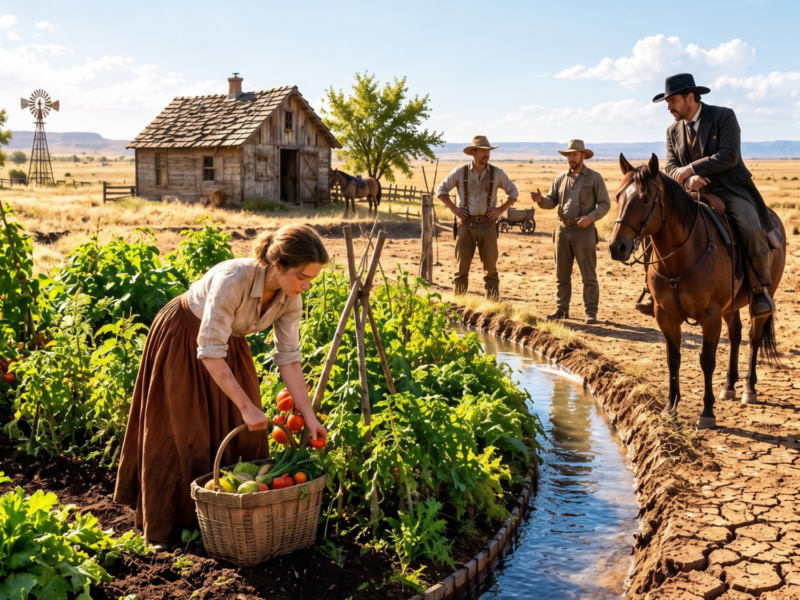
They Laughed at Her “Fool’s Furrow” — Until Her Crops Stayed Green Through the Worst Summer Drought
The Architect of the Earth
June brought the heat, and it brought an unexpected visitor.
Levvenia was hoeing weeds near the berm when a man appeared on the road. He was walking, moving with a slow, deliberate cadence. He was seventy years old, perhaps older, his skin the color of polished mahogany, his face lined with the deep crevices of a life lived entirely beneath the sun.
He stopped when he saw the trench.
He did not call out. He simply stood by the fence line for a very long time, his dark eyes studying the raised berm, the curvature of the contour, and the bright green line of sorghum shooting up vibrantly beside it.
Levvenia walked over to the fence.
“You build a trinchera,” the old man said, his English accented but precise.
“I beg your pardon?”
“A swale,” he said. He had built trenches exactly like this near the Pecos River when he was a young man. His father had shown him the geometry of the earth. His grandfather before that. He unlatched the gate and walked onto her property without asking permission, possessing the inherent authority of an elder.
He walked to the berm. He tested the soil with the toe of his worn leather boot. Then, he crouched down, pressed his bare palm flat against the earth near the roots of the corn, and held it there, feeling the temperature gradient.
“Good depth,” the man nodded, standing back up. “The earth is breathing. But you will want to watch the east end when a true, violent storm comes through. The water will pool too heavy there. You must put a notch in the berm. A spillway. Let it release controlled, or the water will break your wall and take the crop with it.”
Levvenia stared at him. She ran to the cabin and returned with the packet of letters. She pulled out the letter her father had received and pointed to the signature at the bottom.
“Felipe Garza?” she asked.
The old man took the fragile paper. He studied his own handwriting carefully.
“Your father wrote to me,” Garza said softly.
“Yes,” Levvenia said. “But he never answered you.”
Garza folded the letter with great reverence and handed it back to her. “He died before I received his reply. I am sorry for your loss. He was a man who asked good questions.”
Felipe Garza stayed on her claim for two hours. He did not pick up a shovel, but he gave her a masterclass in the ancient hydrology of the desert. He showed her exactly where to cut the overflow notch. He explained how the soil would behave during a torrential downpour, and how it would constrict during a drought. He described the miraculous micro-biology that would occur in the deep heat of August beneath the berm, in the dark, damp places where the killing sun could not reach.
When it was time for him to resume his journey south, he offered no sentimental farewells.
He simply looked out over the curving lines of green. “The trench looks well-built, daughter,” Garza said. “Your father would have been profoundly glad that you came.”
Levvenia kept that sentence locked in her heart for a very long time.









