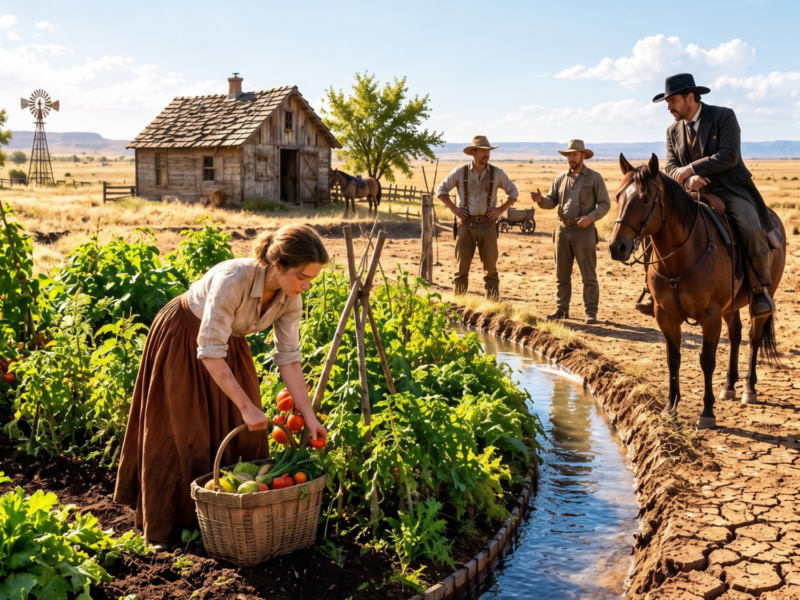
They Laughed at Her “Fool’s Furrow” — Until Her Crops Stayed Green Through the Worst Summer Drought
The Invisible Slope
The next morning, before the sun had fully breached the horizon, Levvenia was outside.
She did not carry a hoe or a bag of seed. She walked every single acre of the claim, moving with agonizing slowness. To the naked eye, to Denton Walls and the men at the feed store, the land looked perfectly flat.
But Levvenia was looking with the eyes of a surveyor. She watched the way the dried buffalo grass bent. She looked at the microscopic sediment patterns left in the dust. She began to see the topography that was hidden in plain sight.
The claim was not flat. It ran slightly downhill from the northwest to the southeast. It was a minuscule grade—perhaps eighteen inches of total drop across the entire one hundred and sixty acres. But gravity was an absolute law. Whenever the spring rains fell, the water took that exact path. It sheets across the hard-baked earth, gained momentum, and disappeared into Perdition Creek within an hour, carrying the rich, vital topsoil away with it, leaving only dust behind.
She went to the shed. She found a hatchet and began splitting an old pine board into dozens of wooden stakes.
For three days, she worked under the brutal sun. She drove stakes into the ground. She tied lengths of white twine between them. She attached a small, weighted plumb bob to the string, checking the absolute level of the earth. She was mapping the contour lines of her property, tracing the invisible elevations.
On the fourth morning, her face burned and her hands blistered, she was crouched near the eastern edge of the property, tying off a string, when the sound of a horse made her look up.
Becket Ferris had stopped his roan along the barbed-wire fence line. He sat in the saddle, his hands resting on the pommel, watching her.
Levvenia stood up, brushing the dirt from her skirt. She walked over to the fence. She explained what she was doing, detailing the geometry and the theory of the contour lines, because she had no reason to hide it.
Becket listened in absolute silence. He looked at the labyrinth of stakes and white string crisscrossing her field. He looked down at the baked, cracked ground.
“What does it accomplish?” he asked finally.
“It slows the rainwater down before it runs off,” Levvenia said, pointing to a line of stakes. “I’m going to dig a trench along this line. It will force the water to sit. It forces it to soak into the aquifer instead of rushing into the creek.”
Becket looked up at the sky. It was cloudless, vast, and blindingly white with heat. Not a hint of moisture hung in the air.
“You’re banking on rain, Miss Hatch,” he said. His voice was careful, analytical, but not unkind.
“I am,” she nodded. “And I am banking on keeping it when it finally comes.”
Becket sat with that for a long moment. He chewed on the inside of his cheek, a farmer calculating a risk that ran contrary to everything his father and grandfather had ever taught him about plowing straight, efficient rows.
“I hope it works,” he said. And looking into his tired, sun-lined eyes, Levvenia realized he truly meant it. He tipped his hat and rode back toward his own dusty, struggling fields without another word.
That evening, by the light of the kerosene lamp, Levvenia took a piece of charcoal and sketched the exact trench line in the margin of her father’s letter, right beside his handwriting.









