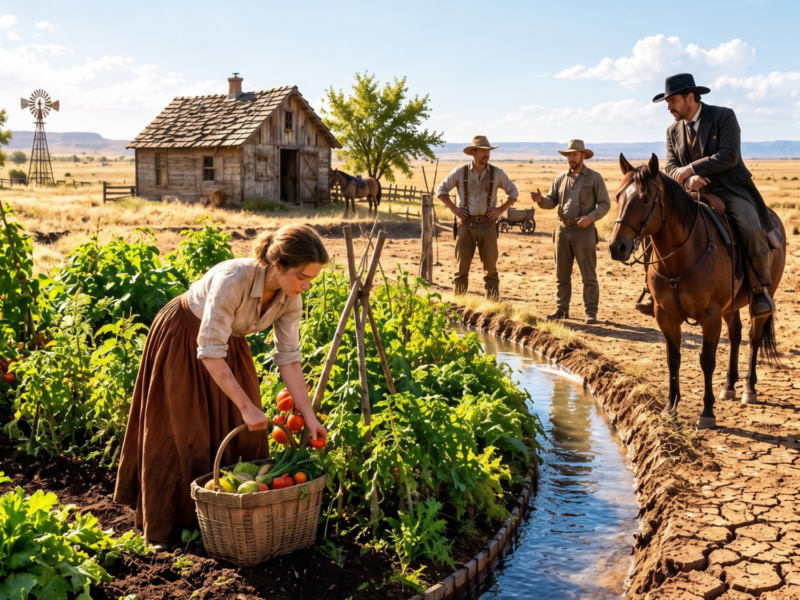
They Laughed at Her “Fool’s Furrow” — Until Her Crops Stayed Green Through the Worst Summer Drought
The Neighbor and the Letters
The neighbor to her east was a man named Becket Ferris.
He possessed one hundred and twenty acres, and he had managed to survive on them for five years—a tenure which, in the brutal arithmetic of Redstone Flat, counted as sheer permanence.
He arrived at her cabin on the third morning. He did not come with grand introductions or nosy questions. He rode up on a tired-looking roan, dismounted, and carried a cast-iron pot covered with a cloth up to her doorstep.
He set it on the rough wooden step. “Beans,” he said.
Levvenia opened the door, wiping dust from her forehead. “Excuse me?”
“Baked beans with salt pork,” Becket said. He was a tall man, lean as a whip, his skin tanned to the color of old saddle leather. He wore an expression of careful, guarded reserve. “Figured you might be too busy fixing that south wall to cook. Also, the nearest working well is at the Bogs place, three-quarters of a mile south. Clementine Bogs says she wouldn’t mind if you drew from it.”
Levvenia looked at the man. She would later come to understand that Becket’s stoicism was not unfriendliness; it was a practiced, necessary armor against wasted hope.
“Thank you, Mr. Ferris,” she said.
He nodded, looking out over her pale, shivering grass. “It’s a hard piece of land,” he noted, his tone observational rather than discouraging. He spoke of it the way farmers mention incoming hail—not as a complaint, but as a geographical fact. “My own crops are struggling. Last two summers were dry. Corn came in light. My well is pulling slower than I like.”
“I appreciate the beans, and the information,” Levvenia said.
Becket touched his hat and rode away. It was not the beginning of a grand friendship, nor a lengthy conversation. It was simply an acknowledgment. They were both there. They were both trying. And the prairie made absolutely no promises to either of them.
In her second week, surrounded by the quiet isolation of the plains, Levvenia finally opened the heavy wooden box her father had shipped west years earlier.
It sat in the corner of the cabin, smelling of cedar and old pipe tobacco. Most of the contents were exactly what she had expected: worn canvas work pants, a rusted crosscut saw, a tin cup, and a folded, fragile map of the county with their claim boundary penciled in with a shaky hand.
But at the very bottom, hidden beneath two heavy wool shirts, she found a packet of letters bound tightly with coarse twine.
She sat at her small, rough-hewn table, lit a kerosene lamp against the falling dusk, and untied the bundle. Many were receipts. Some were unsent letters to her. But one piece of paper caught her eye. It was a letter from a man named Felipe Garza, written in careful, heavily stylized English, dated three years prior.
Levvenia smoothed the crinkled paper and read.
The letter was not about pleasantries. It was an intricate, passionate description of a method Garza had learned from his own father, who had learned it from his father in the arid, punishing deserts of Chihuahua, Mexico.
You do not fight the hill, Elden, Garza had written. You cut the fields across the slope, never down it. You build shallow trenches, running nearly level, following the invisible contour of the land. When the water comes, it is fast and angry. But the trench slows the water. The water is held. It is pushed deep into the ground, rather than racing across the surface, carrying your precious topsoil away to the rivers.
Levvenia stared at the words. At the bottom of the page, in the margin, her father had scribbled a note in pencil.
Creek goes dry July. What if we kept the rain?
Levvenia read that line twice. Her heart began to beat a strange, rapid rhythm against her ribs. She was a mathematician. She understood formulas, variables, and constants.
What if we kept the rain?
She folded the letter carefully, extinguishing the lamp. She sat in the dark, her mind racing with geometry and fluid dynamics, concepts the prairie had never been asked to consider.









