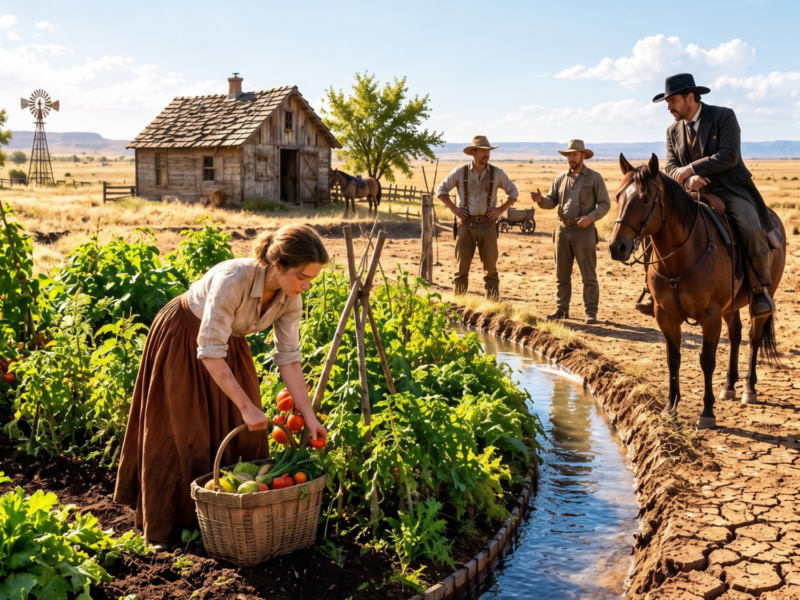
They Laughed at Her “Fool’s Furrow” — Until Her Crops Stayed Green Through the Worst Summer Drought
The Town and the Threat
Redstone Flat was less a town and more a desperate collection of wooden buildings huddling together for comfort. It boasted a livery stable that smelled of manure and liniment, a steepled church in need of paint, a feed store, and a general merchandise emporium simply called Pool’s.
When Levvenia drove her wagon into town two days after her arrival, the rhythmic creak of her wheels seemed to pause the very breath of the settlement. As she pushed open the door to Pool’s, the low hum of male conversation ceased instantly.
A woman alone. An unmarried schoolteacher. A claim that nobody expected to survive the spring, let alone the required five years to prove it up. She was an anomaly, and the frontier did not care for anomalies.
She walked to the counter, her spine stiff. She purchased fifty pounds of flour, a sack of cornmeal, two pounds of dried pinto beans, and a heavy wooden box of mixed garden seeds. Edmund Pool, a balding man with ink-stained fingers, tallied her items with a pencil, volunteering nothing in the way of conversation. Near the potbelly stove—unlit but still the center of gravity in the room—three men watched her openly, not even pretending to look away.
She paid her bill, loaded her supplies into the wagon, and prepared to leave.
“Mrs. Hatch.”
The voice was thick, coated in the kind of confidence that only money can buy. A rider had pulled his gleaming sorrel horse to a stop directly beside her wagon, blocking her path.
He was a heavyset man, tailored in a fine wool suit and a pristine Stetson, dressed in the manner of someone who desperately wanted to be taken for a rugged rancher. But Denton Walls had made his fortune buying cattle from desperate men, not raising them himself. He owned the water rights to a vital half-mile stretch of Perdition Creek to the west, and for three years, he had been quietly, ruthlessly acquiring every adjacent claim through foreclosure and intimidation.
He did not remove his hat.
“Miss Hatch,” Levvenia corrected, her voice carrying the precise, cutting diction of a schoolteacher addressing a wayward pupil.
Walls offered a slow, oily smile. “I heard you came all the way out here to see old Elden’s property. Smart woman. Best to see a ruin for yourself before deciding what to do with it.”
Levvenia wrapped the leather reins around her hands. She said nothing.
Walls rested a thick forearm across his silver-chased saddle horn. He leaned in, lowering his voice to a conspiratorial rumble. “That claim of yours sits right between my east fence and the bend in Perdition Creek. It’s useless to a farmer, but it squares up my pasture nicely. I’d offer you eighty dollars for it today. Cash money. Save you the sweat and the heartbreak of trying to prove it up. You can be on the train back to Ohio by tomorrow evening.”
Levvenia looked past him, her eyes tracing the dry, dusty scar of the creek visible past the edge of the town buildings. Elden Hatch had filed that claim while coughing up blood, sick and dying, two months before the end. He had wanted a piece of the earth to call his own.
“It is not for sale, Mr. Walls.”
Walls chuckled. It was a deeply condescending sound, the chuckle of a predator who believes his prey’s refusal is merely temporary.
“There’s no urgency, Miss Hatch,” he said smoothly, tipping his brim at last. “The summer is long. The sun is hot. I’ll be around when you change your mind.”
He turned his horse and rode north toward his sprawling estate. Levvenia stared at his broad back for a moment, her jaw tight, before flicking the reins and driving her wagon back toward the dust of her claim.









