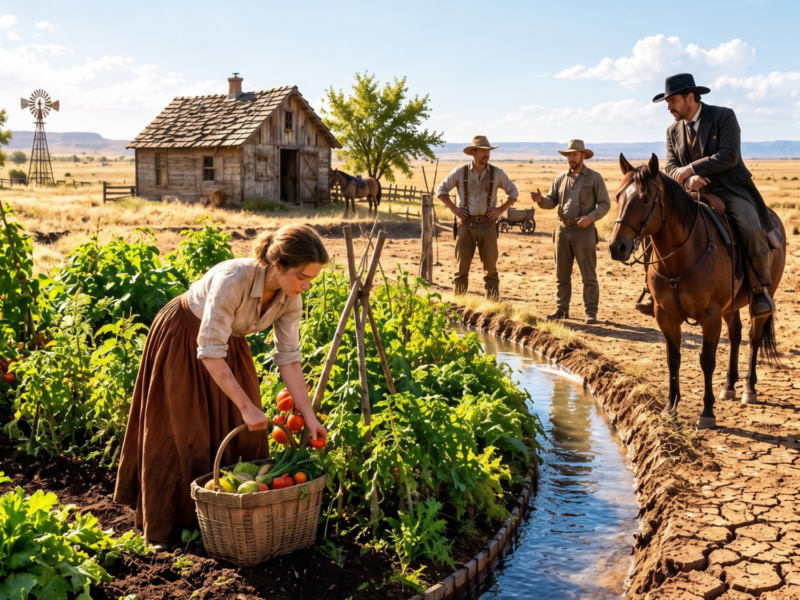
They Laughed at Her “Fool’s Furrow” — Until Her Crops Stayed Green Through the Worst Summer Drought
The Crucible of July
July arrived in Redstone Flat without announcement, and without a single drop of mercy.
The sky simply stopped working.
It became a vaulted dome of punishing, relentless blue. Clouds would occasionally appear on the western horizon in the late afternoons, teasing the farmers with the scent of ozone, only to dissolve into cruel wisps of vapor before they ever reached the county lines.
What had begun as a dry spring rapidly mutated into something much harder to name. It was a desiccation. A strangulation.
By the second week of July, the farmers across the county were loading wooden barrels into their wagons, driving miles to haul stagnant, muddy water from whatever small, evaporating pools Perdition Creek still held.
By the third week, Perdition Creek had gone back to dry, baking stones. The wells began to suck mud.
Levvenia walked her trench line every morning before the sun crested the horizon and the heat became physically dangerous. What she saw in her fields defied every tenet of agricultural reasoning her neighbors held sacred.
Her sorghum stood six feet tall, vibrantly green and straight as an arrow. The corn stalks were thick, the ears swelling, the leaves broad and open, refusing to roll up and defend themselves against the sun. The winter squash vines had exploded, spreading massive, parasol-like green leaves across the ground near the berm, shading the soil and creating their own humid micro-climate.
Levvenia would kneel, dig six inches down into the soil near the berm, and press her hand into the earth. The moisture was still there. It wasn’t wet, but it was profoundly present. It was cool to the touch. The dirt was dark, bound together by hydration, rather than the pale, blowing dust of the surrounding claims.
She said absolutely nothing about this in town. She did not have to.
By the last week of July, wagons were slowing down on the road that ran along the south edge of her claim. Men were stopping their horses just to sit and stare at the impossible oasis of green surrounded by an ocean of dying brown. They did not look amused anymore. The mocking smiles were gone.
Becket Ferris came on a Tuesday morning.
He rode up to the fence line and dismounted. His hat was coated in white dust, his shoulders slumped, and he possessed the haunted look of a man who had not slept deeply in a month. His own cornfields, planted so efficiently in straight vertical rows, had gone stiff and pale yellow—the horrific color that comes right before a field surrenders and dies entirely.
He stood at the barbed wire and stared at her towering, emerald-green crops for a long, long time.
Levvenia walked over to him, her hands in her apron pockets.
“How much of it is the trench?” Becket asked, his voice cracking with dry dust.
“All of it,” she said honestly.
He was quiet. He looked down at his boots, kicking a clod of dry dirt that shattered into powder.
“I should have asked you a lot more questions back in April,” he murmured.
Levvenia thought about that. She thought about a proud man standing at a fence line three months ago, deciding not to take a risk because it ran contrary to everything he knew. She understood the crushing weight of that regret. She felt no desire to gloat.
“Come over the fence, Becket,” she said softly. “Come look at it. See what you can use for your own land before next year.”
They walked the entire length of the trench line that sweltering afternoon. She showed him the overflow notch Felipe Garza had designed. She showed him the precise depth of the berm, the mathematical slope of the swale, and the way the root systems of the squash had bound the earth together to prevent evaporation.
Becket asked incisive, brilliant questions. He wrote nothing down, but Levvenia could see his eyes mapping the topography. He was already building the trenches on his own land in his mind.









