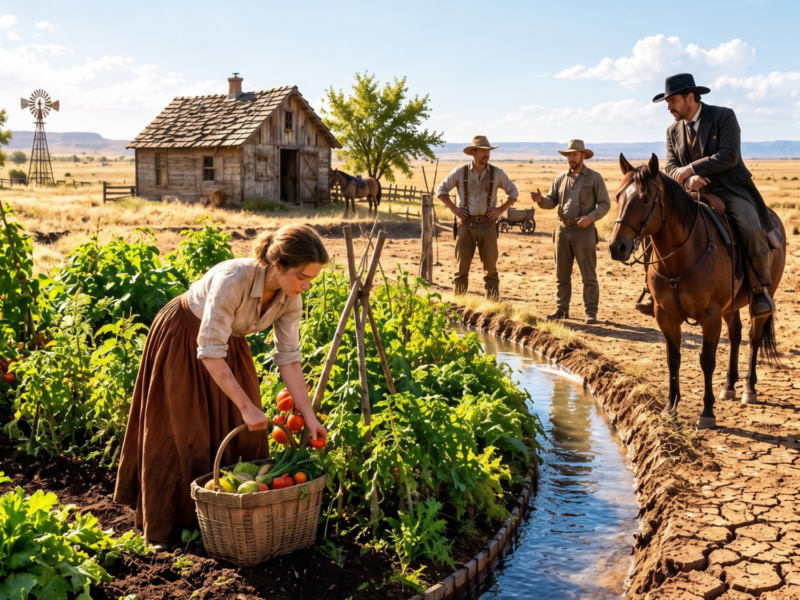
They Laughed at Her “Fool’s Furrow” — Until Her Crops Stayed Green Through the Worst Summer Drought
The Harvest and the Horizon
The rains finally returned in September.
It was nothing dramatic. There were no booming thunderstorms or destructive floods. It was just steady, quiet, gentle showers moving through the plains in the cool evenings—the way the prairie sometimes remembered that it owed something to the fragile people who were bleeding to work it.
By October, the landscape of Redstone Flat had physically changed.
Three new, massive trench lines had appeared, carving serpentine curves across the topography. One of them was on the Ferris property. Becket had started digging it by hand in late August, days before the court hearing, because he had already made his own decision about the truth of the earth, regardless of what a judge in a hot room had to say about it.
The two other trenches belonged to desperate families Levvenia barely knew, who had copied the design from watching her land from the road.
Nobody called them Fool’s Furrows anymore. They called them contour swales.
Levvenia planted winter wheat that fall along the saturated earth of her berm. Because of the deep, trapped moisture, the wheat sprouted and came up a vibrant, shocking green in November, an occurrence which was highly unusual for the region. She meticulously recorded the emergence date in her journal.
One bitterly cold afternoon, Becket rode over to her claim. He knocked on her door, removing his hat. He had a highly technical question about the precise depth of an overflow notch for his own new trench.
Levvenia invited him in out of the wind. She poured two cups of hot coffee. They spread her father’s map and Felipe Garza’s letters across the small wooden table. They stayed there through the evening, working on the mathematical problem of water flow and soil retention together.
They talked long past dark. They talked about the land, about the future, about the things they had both lost, and the things they were slowly building.
Outside the window, a brilliant half-moon lit the dormant field. The great trench ran its graceful curve through the silver moonlight like a deliberate sentence written upon the earth. The land was still punishing, but it was no longer a mystery.
Felipe Garza passed through the county again in late December, bundled in a heavy wool serape. He stopped his horse at the fence line. He looked at the impossible, vibrant green of the winter wheat rising against the snow. He stood in silence for a long while, the wind pulling at his white hair.
Then, he turned to Levvenia, who was standing on her porch. “Your father would have been profoundly glad, daughter,” Garza smiled. “And my father, too.”
The following spring, as the prairie thawed, Levvenia received a piece of mail. It was a letter from a woman homesteading in the arid, brutal panhandle of western Texas. The woman had heard a wild story about a magical trench in Kansas from a passing freight driver.
The letter was desperate. It asked practical, desperate questions: What are the measurements? What is the soil type? What is the best time of year to build? How do you handle a topographical slope that runs from south to north instead of east to west?
Levvenia sat at her desk. She sharpened her pencil. She answered every single question. She sent back three pages of highly detailed mathematical instructions, accompanied by a precise, hand-drawn sketch of the contour lines.
She never met that woman in Texas. She never would.
But the idea had moved. It moved the way water moves—not in a loud, destructive, straight line, but just steadily, patiently, following the path of least resistance, finding its way toward the dry, desperate places that needed it most.
Perdition Creek still ran dry every single July. That geographical fact had not changed, and the heavens dictated that it probably never would.
But along the homestead claims that bordered the dry draw, the land had learned something profound about patience. The earth had been taught to hold what the sky sent, to store the treasure deep in the dark, rather than helplessly watching it disappear before the ground could take it in.
Levvenia Hatch stood atop her massive berm on the last day of October. She looked west into a flat, endless horizon where the autumn sun was sinking, turning the sky a brilliant, bruised orange.
The trench beside her was quiet, pregnant with moisture. The wheat behind her was a defiant, screaming green.
She thought about her father, Elden, a man who had asked the exact right question, but whose heart had quit before he ever lived to dig the answer. She thought about Felipe Garza’s dark, calloused palm pressed flat against the breathing earth, passing down the ghosts of his ancestors.
She thought about Becket Ferris’s voice in the sweltering hearing room, steady and plain, choosing the truth of his own eyes over the pride of the town. She thought about a desperate woman in Texas, who had just finished reading three pages of careful instructions, and was probably, right at this very moment, driving a wooden stake into the baked ground and running a white string toward the next one.
The wind moved fiercely across the Kansas prairie, whistling through the pale grass, without stopping anywhere.
But beneath Levvenia’s boots, the land held what it was given. And for the first time in a long time, that was enough.









