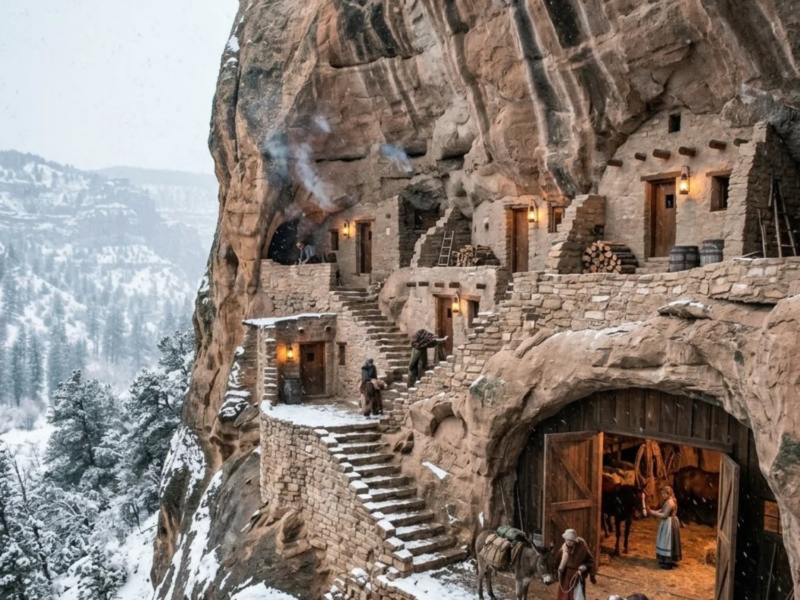
She Built a Barn Beneath a Sandstone Cliff—Then a Blizzard Destroyed Every Other Barn
The Winter Sanctuary
The wall rose to its full height in the first week of November. She fitted the last stones at the top with a mallet and a chisel, tapping them into place with the care of a jeweler setting a stone, because the top course had to bear against the underside of the natural roof without leaving any gap a wind could find.
She left the windows unglazed, covered instead with squares of oiled canvas she could roll down in bad weather and roll up in good, because glass cost money she did not have and canvas would keep the animals warm enough for one winter. She would replace it in the spring—or she would not, if the country would not permit her a spring.
The interior took another week. She built the stalls from the last of the pine: three for the cows, one for the mule, a pen for the pigs, a roost for the hens against the warm back wall. She built a ladder to the loft and hauled hay up a fork at a time while Wesley pitched from the wagon and she stacked, and by the end of the week the loft was full enough to feed the animals through February even if the country stayed white to April.
She dug a shallow drainage channel along the near wall and lined it with flat stone so waste could be swept clean. She whitewashed the front wall inside with a lime wash that made the whole space seem twice its size when the door was open and the sun came through.
On the eighth of November, she stood in the doorway of the finished barn and looked in.
The cows had come in that morning of their own accord, drawn by the hay, and were standing in their stalls with the composed dignity of animals that had recognized a good roof. The pigs were rooting in fresh straw. The hens had already claimed the highest perches. The mule stood at the door of his own stall and looked at her with the patient, half-lidded eye of a creature reserving judgment.
Above them all, the natural roof of red sandstone arched, and along its inner curve, faintly in the lantern light, she could still see the spiral and the snake and the sun, as if the ancient hands that had made them were watching now to see what she would do with the shelter they had left.
She heard footsteps behind her. Margaret Dunore had come up the wash on foot, a covered basket over her arm. She stopped at Harriet’s shoulder and looked into the barn a long time without speaking. When she did speak, her voice was smaller than Harriet had ever heard it: “Lord have mercy. It is built.”
Harriet did not turn her head. “It is built.”
Margaret set the basket down. “Sweet girl, I have said things about you at my own table. I would take them back if I could. I do not know whether the winter will prove me right or wrong about the cold in that rock. I know only that you have done a thing I did not believe a woman could do, and that I was one of the ones who told you so.” She paused; the wind moved her shawl. “I am sorry.”
Harriet turned then. She looked at Margaret’s face—which had grown older by ten years since the church social in August—and she saw in it not pity now, but something else, something that did not have a name in the vocabulary the country had given its women. She reached out. She took Margaret’s hand, held it a moment, and let it go.
“Come inside,” she said. “See it from the inside. The rock speaks differently from within.”
They stood together in the barn a long while, and Wesley came in and took the basket without being asked, and outside the wind began to lift the tops of the cottonwoods with the first true cold of the season. Margaret left before dusk, walking back down the wash the way she had come, her shawl pulled close, and Harriet stood in the doorway and watched her go until she was a small, dark figure against the pale grass.









