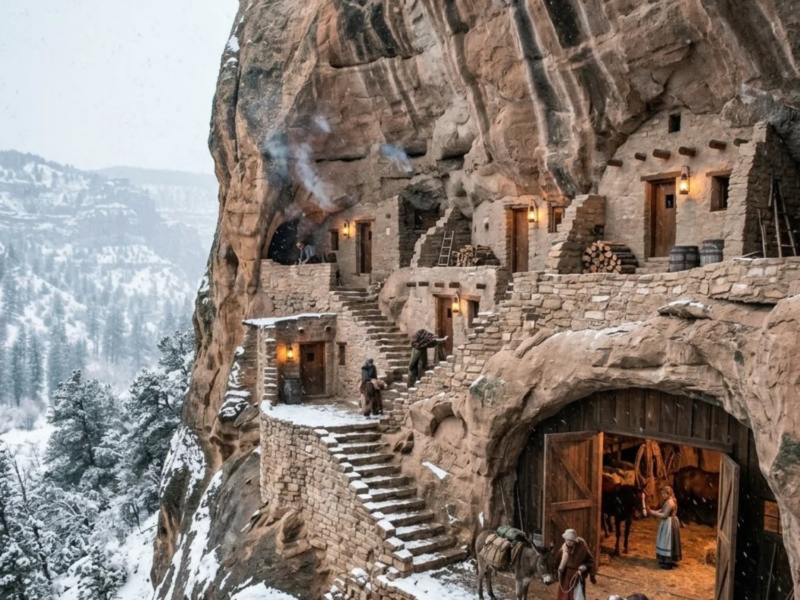
She Built a Barn Beneath a Sandstone Cliff—Then a Blizzard Destroyed Every Other Barn
The Courtroom in Prescott
The territorial surveyor, Henry Witcom, rode into Coyote Wash on the second of January in a rented buggy with a spare wheel lashed to the back and a leather portfolio on the seat beside him. He was a small, tidy man from Ohio by way of Denver, with round steel spectacles and the polite curiosity of a person whose work was to see things clearly and describe them accurately. He had heard the story in Prescott from three separate mouths in the course of one week and had come out to see for himself.
He introduced himself at the cabin door with his hat in his hand and asked with real courtesy whether he might be permitted to examine the structure and speak with its builder about the methods employed. Harriet spent two hours with him in the barn. She showed him the anchor holes, the wooden wedges, and the way the wall leaned into the mountain. She showed him the drainage channel, the framing of the door, and the pintles. She answered his questions plainly, without hedging or decoration.
He wrote quickly in a small bound notebook with a pencil sharpened to a needle. He made a rough sketch of the elevation and a rougher one of the plan, and he measured with a folding rule that he snapped open and shut with the fond care of a man handling a favorite tool. When he was done, he closed the notebook, looked at her a long moment, and spoke with a formality she had not heard from a man in six months:
“Mrs. Maddox, I have surveyed for the territorial land office for eleven years. I have seen homesteads from the Kansas line to the Colorado River. I have not seen a thing like this. You have not built a barn. You have recovered a way of building. My report to the governor will name you, if you permit it, as a person whose method other homesteaders in this territory ought to be encouraged to study.”
She permitted it. He tipped his hat, climbed into the buggy, and drove down the wash the way he had come, the dust of his wheels gray now with the first thaw of the month. She watched him go with a stillness in her chest that felt almost like grief, though she could not have said why.
The hearing was held in Prescott on the fifteenth of January in a plain courtroom with a coal stove in the corner and a judge named Alonzo Harden on the bench.
Judge Harden was sixty-two years old. He had come out from Missouri in 1868 and had been on the territorial bench for eleven years. He wore no robe—only a black coat and a string tie—and he listened with the kind of stillness that makes a lawyer choose his words more carefully than he had planned to.
Bragg was there in his good coat. Greerson was there with his portfolio. Harriet was there in the morning dress she had not put on since February, brushed clean, with a collar of white lace at her throat Margaret Dunore had lent her the night before. Wesley sat on a bench behind her with his hair combed flat, holding a hat between his knees. Silas Dunore sat beside him. Robert Whitlock, Robert Kemp, Amos Ashford, and two other neighbors filled the bench behind them. Margaret Dunore sat at the end with her hands folded in her lap and her eyes on the back of Bragg’s neck.
Greerson made his opening. He spoke well. He used the phrases he had used in the yard and added others prepared for the ear of a judge, making Harriet’s undertaking sound like a course of self-destruction pursued in defiance of every reasonable counsel. He offered into evidence a letter from Reverend Holloway—which pained Harriet in a private way, but which she had known was coming—and a statement from Bragg himself as a witness to the mother’s refusal of neighborly advice.
Then it was her turn. She had no attorney; she had refused one, though the surveyor Witcom had offered to find her one in Prescott at his own expense.
She rose, walked to the small table at the front of the room, and placed her hands on it. She spoke in the plain voice she used to teach her son his letters:
“Your Honor, I built a barn. My son is warm and fed. My neighbors’ animals are alive tonight because of what I built. The petition before you asks you to take my son from me on the ground that I have built the wrong sort of shelter. I would like to call witnesses.”
She called Silas Dunore. He rose, walked to the table, and was sworn. He looked once at Bragg and once at Harriet, and then he looked at the judge and told the court what he had told her at the barn door on the third evening after the storm. He did not soften it. He did not spare himself. When he named the boy who had been paid to ride to California, Greerson objected on grounds of hearsay; the judge sustained the objection, and Silas continued past the objection to describe what he himself had refused and what he himself had suspected.
When he was done, the courtroom was so quiet that the coal in the stove could be heard shifting.
She called Robert Whitlock. She called Robert Kemp. She called Amos Ashford. She called Margaret Dunore. Each of them testified to the barn she had built, the animals she had sheltered, and the counsel she had given them in the days after the storm about how their own new barns might be built to survive the next one. Margaret, when her turn came, looked directly at the judge and said:
“Your Honor, I told this woman to her face that a woman alone could not do what she has done. I was wrong. If any child in this territory is safer than the boy behind me, I would like to be shown him.”
Judge Harden let the silence sit a moment. He looked at the petition. He looked at Bragg. He looked at Harriet. He spoke:
“Mr. Greerson, I have heard your petition. I have heard the witnesses. I find no evidence of danger to the minor child; I find, on the contrary, evidence of a mother of unusual competence and of a community that has been served by her competence. The petition is denied.”
He set the paper down and looked at Bragg for a long count of five.
“Mr. Bragg, I will not make findings today on the matters Mr. Dunore has raised, because the evidence for a criminal proceeding has not been laid before me and this is not the forum for it. I will say for the record of this court that I have taken note of what has been said in my hearing today, and that I am a judge who remembers what he hears. Good day to you all.”
He rose and left the bench. The room emptied slowly. Bragg walked out without looking at anyone; Greerson followed him, portfolio under his arm, the polite mask of his profession fitted back into place. Harriet stood at the table with her hand still on the wood. Wesley came up to her and pressed his forehead against her hip. She put a hand on the crown of his head. She did not speak for some time.









