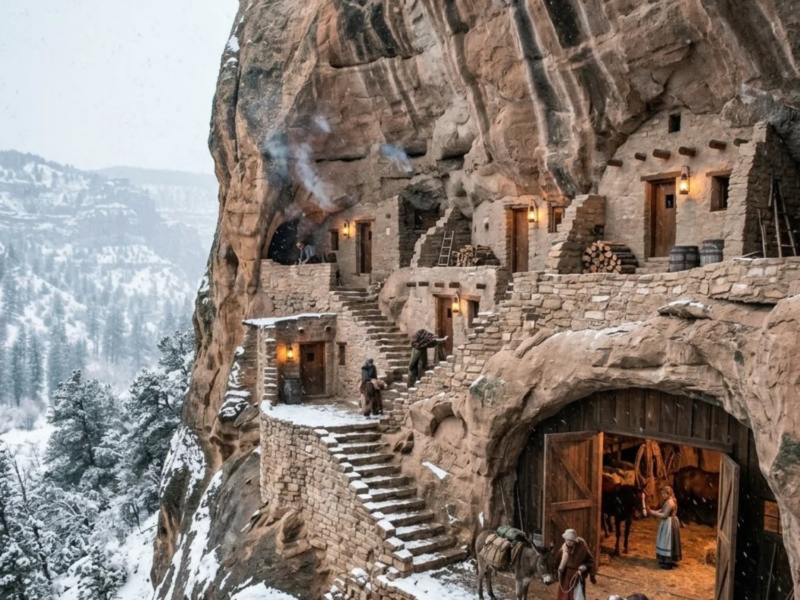
She Built a Barn Beneath a Sandstone Cliff—Then a Blizzard Destroyed Every Other Barn
Epilogue: The Rock Remembers
The barn stood.
It stood through the winter of 1888 and the winter after that. It stood through the drought of 1893 and the wet spring of 1897. It stood while Wesley grew into a young man and left for a year to work in a lumber camp up on the Mogollon Rim, and it stood while he came back and married a girl from Al Creek Crossing named Kora, and it stood while their first child was born in the cabin his father had raised.
Harriet lived to see her grandchildren. She died in the winter of 1911 at the age of fifty-six in her own bed, of a pneumonia she had caught nursing a neighbor’s child through the same illness. She was buried beside Ezekiel under the cottonwood at the head of the wash. Wesley set the stone himself, cutting it from the same soft sandstone she had used for the barn wall, shaping it with her mallet and her chisel. The letters he cut into it were plain, level, and true.
Forty years after the winter of the storm, in the fall of 1927, an old man walked up Coyote Wash with three children beside him. He was tall and stooped, with white hair under a good felt hat, and he carried a walking stick he did not lean on. The children were his grandchildren; the oldest was ten. They had come down from Flagstaff on the new road and left the automobile at the mouth of the wash because the automobile could not follow where the old wagon track had gone.
The cabin had been gone thirty years. The cottonwood still stood. The spring still ran.
The barn was there.
The old man stopped at the open door of it. He did not go in at first. He put his hand flat on the stone of the wall beside the door at a place where the mortar was cracked but the stones were still fitted true, and he stood a long moment with his eyes closed. The children waited; they had been told on the way down that they were going to see something, though they had not been told what.
He opened his eyes. He led them inside.
The barn was empty of animals now, and its loft was empty of hay, and dust hung in the shafts of light coming through the canvas windows where the canvas had long since rotted to nothing. The beams overhead were dark with age, but sound. The stone of the walls was cool to the touch. On the back wall, where the light fell full in the late afternoon, the ancient carving of the spiral, the snake, and the sun could still be seen—faint, but there, older than any of them.
The old man knelt down in front of the youngest child and spoke to her at her own height. His voice was thin now, but it carried—the voice of a man who had been telling the story to himself for a long time and had at last found the right audience:
“Your grandmother built this with her own two hands. Every stone in this wall she cut. Every beam over your head she raised. Every neighbor for twenty miles told her it could not be done. She was a widow. I was seven. We had four cows and no money and no help, and the winter was coming.
“She did not listen to the neighbors. She listened to a book of pictures I showed her one night, and she listened to the shape of the mountain, and she listened to something inside her that most people spend their whole lives afraid to hear.”
The child looked at her grandfather. She put her small hand on the stone beside his. She did not speak; she understood, in the way a child understands what she cannot yet put into words, that she was being handed something.
He rose. He looked around the barn one last time. He said, more to himself than to the children, the sentence his mother had said to him at the door of it on the evening the surveyor from Ohio had driven away:
“Sometimes the strongest answer a person can give to being laughed at is to keep laying stones one at a time until the work speaks for itself.”
He walked out into the late light. The children followed.
The barn stood behind them, empty and full at once—its door open to the afternoon, its walls holding the shape a woman had given them in the summer of 1887 against every voice that had told her the shape could not be held. Above the rim of the canyon, the same ravens that had watched the first hammer blow watched now—or their great-grandchildren did, which in that country came to the same thing.
The old man walked down the wash with the children. The cottonwoods moved above them the way cottonwoods have always moved above people walking down washes in the West, with a sound like water always about to arrive. Behind them, the barn stood in the shadow of the cliff, patient as a tool that had waited for its work and had not been asked to wait in vain.
That was the way it ended, and that was the way it had begun: a woman with a hammer, a boy with a bucket, a wall that everyone said would not stand.
It stood.









