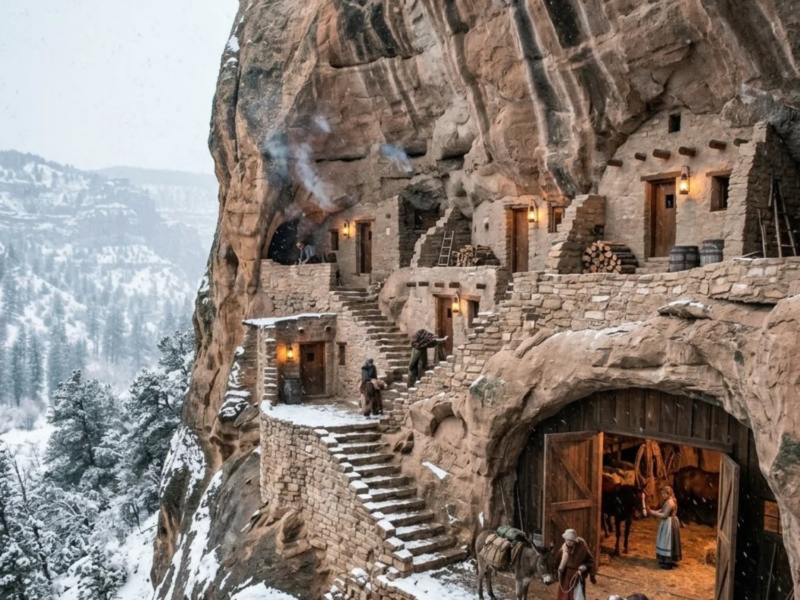
She Built a Barn Beneath a Sandstone Cliff—Then a Blizzard Destroyed Every Other Barn
The Weight of Scorn
She spent the next week measuring. She sketched on the backs of seed catalogs and blank pages torn from Ezekiel’s ledger. She paced the alcove until she knew its floor in her sleep. She climbed the rock slide beside it and looked down on the roof to be sure it was solid, thumping the sandstone with a hammer handle and listening for the hollow note that would have told her to turn away. The note was solid. The stone spoke back like a struck anvil.
Her father’s voice came to her out of memory: Rock will tell you what it wants, girl, if you have the sense to shut up and listen.
The first time she told another human being what she meant to do, she was standing on the trampled grass behind the little clapboard church at Al Creek Crossing, holding a plate of dried apple pie she had not touched. Margaret Dunore—Silas’s wife, a woman of great kindness and greater certainty—laid a hand on Harriet’s wrist when she said the word alcove. The pity in her face was the worst of what came that afternoon.
“Sweet girl, a woman alone cannot do such a thing. No one can, without mining equipment and a crew.”
Robert Whitlock, who ran cattle up on the mesa, put down his coffee cup with the care of a man setting down an argument. “The old people used caves that were already made; they did not carve them. And even if you could hollow out that space, Mrs. Maddox, how do you frame the opening? How do you hang a door on a mountain?”
“I will figure it out,” she said. The words came out smaller than she had meant them to, and she watched them fail to travel more than three feet before the wind of their disbelief blew them back.
Reverend Holloway, who had baptized Wesley and buried Ezekiel with the same soft hands, drew her aside at the water barrel and suggested with real tenderness that perhaps it was time to write her cousin in Prescott. There was no shame, he said, in a woman letting her family carry her a while. There was no shame in selling. The land would find a buyer; she and the boy would find a life. He meant every word of it as mercy.
She left the social before the sun went down. On the wagon road, she overheard two voices she did not identify because she did not want to know which of her neighbors had spoken. The first said low that grief did strange things to a woman’s mind. The second answered that someone ought to have a word with her about the boy before something happened that could not be undone. The words rode home in the wagon with her and would not get down. Wesley curled against her side under the buffalo robe, felt her stiffen, and reached up without looking to pat her arm the way she had patted his when he was three.
They began work the next morning at first light.
She cleared the alcove floor first, hauling out the litter of fallen stone in a wheelbarrow whose wheel Ezekiel had trued the summer before he died. Wesley carried smaller rocks in his bucket, and when the bucket grew too heavy, he tipped half of it out and carried the rest; and when even that was too much, he sat in the shade and sorted stones by size so his mother would not have to bend for them later. They worked from dawn until the heat drove them out at noon, and then again from the long afternoon until the light failed.
By the end of the second week, the floor was clear enough to walk without watching your feet. By the end of the third, the back wall stood scrubbed of loose grit, and its curves and hollows had begun to speak to her the way a bolt of cloth speaks to a seamstress. That was when the drilling began, and that was when Silas rode up laughing.
His laughter set a pattern the neighbors kept for weeks. Wagons slowed on the road above the wash so families could point down at her from the safety of their seats. A boy from the Ashford place, no older than twelve, cupped his hands around his mouth one afternoon and hollered down to ask if she had struck any gold yet, and his father did not correct him. The Kemps rode past on their way to Prescott and did not wave. Margaret Dunore brought her a jar of preserves one Wednesday and did not go near the alcove, keeping her eyes on the cabin door as if the cliff might reach out and pull her in. Harriet accepted the preserves with real thanks. She did not stop working long enough to open them.
She had chosen eight sites along the alcove’s throat for the anchor holes. Each site had been read three times: once for the grain of the rock, once for the angle the future beam would want, and once for what her father called the honest test—striking the spot with a bare knuckle to hear whether the sandstone rang true or muttered. Six of the eight sang. Two, she moved a hand’s breadth to find sights that would not betray her.
Then she set the drill and began the ancient repetition: strike, turn a quarter, strike, turn a quarter. The star tip bit the rock a hair at a time. The dust welling up around it collected in the little basin of stone, and Wesley brushed it away with a horsehair brush Ezekiel had used for tack.
On a good day, she went a full inch deeper. On a bad day, she went half of that and paid for it with a wrist that throbbed against her ribs when she tried to sleep.









