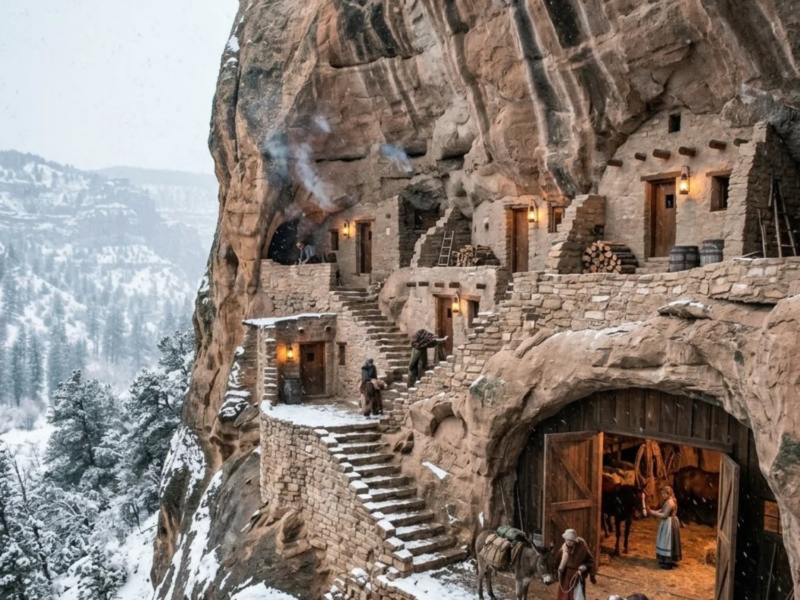
She Built a Barn Beneath a Sandstone Cliff—Then a Blizzard Destroyed Every Other Barn
The Sheriff and the Writ
The wall climbed to shoulder height by the end of the third week of October. She hung the door on its wooden pintles and gudgeons in the last days of the month, and when she swung it closed for the first time, it settled against the jamb with a soft, satisfied thud. Wesley, watching from the alcove floor, gave the small, crooked smile she had not seen on him since February.
Cornelius Bragg came back on the second of November. He did not come alone.
He brought a man in a black coat who introduced himself in a Boston accent not softened by the West as Mr. Alden Greerson, attorney at law, member of the bar of the Arizona territory, practicing out of Prescott. Greerson wore a small round pair of spectacles, carried a leather portfolio, and had the courtesy of a man who had been paid enough to bring his manners with him. He removed his hat and asked to be permitted to speak with her on a matter of legal importance concerning the welfare of the minor child in her custody.
She let them stand in the yard. She did not offer them chairs. Wesley was in the cabin, and she had told him with a look to stay inside, knowing when she said it that she would owe him an explanation before nightfall.
Greerson opened the portfolio. He drew out a document. He read it aloud in the careful, expressionless voice attorneys use when the words themselves are meant to do the wounding: a petition filed on behalf of a party concerned for the welfare of Wesley Maddox, minor child, aged seven years, on the grounds that the mother of the said minor had, since the death of her husband, undertaken a course of conduct dangerous to the child and evidencing a diminished capacity for judgment—to wit, the attempted excavation of a habitable structure from a natural rock formation employing explosive and impact tools without professional supervision, the said mother having repeatedly rejected the counsel of her neighbors, her clergy, and persons of standing in the community.
The petition prayed the court for an order removing the said minor from the custody of the said mother pending a full hearing, and appointing suitable guardians of the court’s choosing for the interim.
Greerson lowered the paper. He watched her. Bragg watched her, too, his face very still. He was waiting to see her break. She could feel him waiting the way a horse feels the wolf behind it in the dark.
She did not break. She felt something inside her go very cold and very quiet, the way water goes still just before the first ice, and out of that quiet she heard her own voice: “When is the hearing?”
Greerson consulted the paper. “The fifteenth of January in Prescott, before Judge Alonzo Harden.”
Bragg spoke then, his voice as gentle as if he were offering a child a peppermint: “Mrs. Maddox, there is no need for any of this to go to the court. I am prepared to withdraw the petition today, and my offer for the land stands, and I will add one hundred dollars for your inconvenience. You and the boy would be in Prescott by Christmas. Warm rooms, a schoolhouse for him, a church you could reach without a wagon.”
The wind moved in the cottonwoods above them. Somewhere in the alcove, a chicken cackled. Harriet looked at Cornelius Bragg for a long count of ten before she answered. Then she said the sentence she had not known she owned until it came out of her:
“Mr. Bragg, my son will sleep tonight under a roof his mother built, and he will sleep under it every night for the rest of his childhood, and no paper you can buy in Prescott will change that. You may take your petition to the fifteenth of January. I will see you there.”
Greerson closed his portfolio. Bragg tipped his hat with a courtesy that had nothing behind it. They climbed into the surrey and drove away. She watched the dust hang above the road long after the rig was gone.
That night, she cried for the first time since Ezekiel had died. She did it in the cabin with the lamp turned low, sitting at the table with her hands over her mouth so the sound would not carry to the loft where Wesley slept. She cried without knowing whether it was for her husband, her son, her own body that would not stop hurting, or the wall that had grown so high and still had not grown high enough.
When she was done, she washed her face, banked the fire, climbed the ladder to the loft, and lay down beside her son without waking him. He turned in his sleep, put a small hot hand against her throat, and said in the mumbling voice of a child who is half in dream: “The barn will show them, Mama.”
She lay awake until dawn holding that hand against her collarbone.









