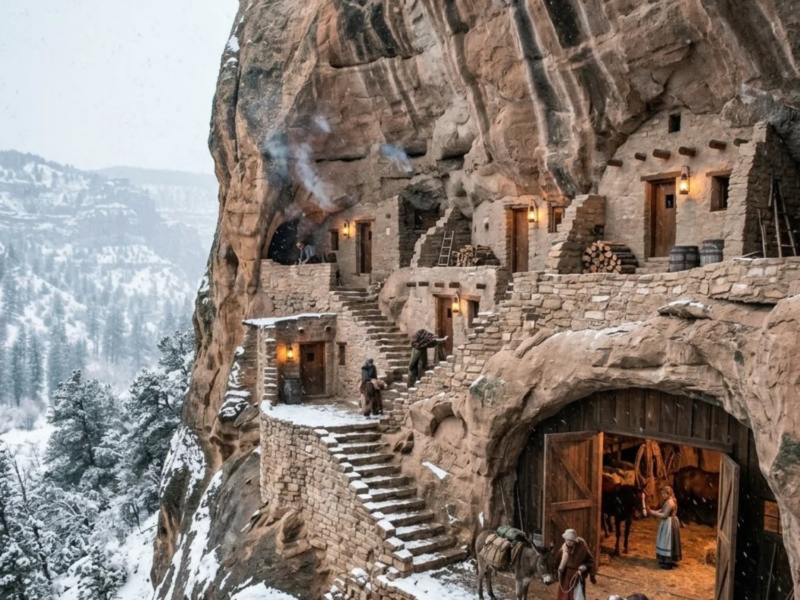
She Built a Barn Beneath a Sandstone Cliff—Then a Blizzard Destroyed Every Other Barn
Raising the Beams
Morning came clear and cold enough to promise fall. She dressed by lamplight, drank her coffee standing, and tied her hair back with a strip of blue cotton that had once been the trim of a dress. Wesley met her at the door with his boots already on.
They walked out together into the shadow of the cliff. The first light was just beginning to color the top of the rim above them, and the star drill lay where she had left it the night before, patient as a tool that had waited for its work. She lifted it. She set it against the mark she had made with a nail the day before. She took the sledge in her right hand and settled her feet the way her father had settled his weight: even shoulders, loose grip, breath low in her belly.
Above her, on the highest branch of the tallest cottonwood, a raven turned its head to watch, and the wash was so still she could hear the water in the spring.
She struck. The blow rang out. Wesley moved to his place with the brush. She turned the drill a quarter. She struck again. The sound went up the canyon and came back to her from the far wall, softened as if the canyon itself were answering. She struck a third time, and a fourth, and by the tenth she had lost count of the count, and her body had settled into the rhythm that would carry her through the fall.
By the second week of drilling, the canyon had learned the sound of her hammer the way a household learns the sound of a clock. The first hole reached eleven inches on a Tuesday morning, which she marked with a nail scratch on the handle of the sledge, and she did not permit herself to feel more than a moment of it before she moved the drill to the next site and began again.
Eleven inches was a beginning. She needed each hole to reach twenty at least in eight of them, and the equinox was already tilting the shadows longer along the alcove floor.
She had begun to walk differently. The muscles across her shoulders had thickened enough that her Sunday dress no longer sat quite right at the seams, and she had let it out at the armholes with a needle by candlelight rather than take a day away from the wall. Her forearms had darkened where her sleeves rode up. When she caught sight of herself one morning in the small square of mirror above the washstand, she did not recognize the woman looking back until she looked twice. The mouth was still hers. The eyes were harder. The braid was shorter, cut off at the collar with the sewing shears the week before because the dust would no longer wash out, no matter how long she stood over the basin.
Wesley had grown, too—not in inches, but in the way a boy grows when a father goes and does not come back. He rose without being called. He brought his mother her coffee in a tin cup before she had her boots laced. He had learned to keep the fire banked overnight so the cabin never went cold, a task Ezekiel had done for the whole of their marriage without her noticing. The first morning she found the coal still red under the ash, she had put a hand on the back of Wesley’s neck and left it there a long moment before turning to the stove. Neither of them spoke of it. The boy was learning what the country asked of its people, and it was asking early.
Silas came on Wednesdays. He had made a habit of it, and the habit had begun to feel to Harriet like the visits of a doctor to a patient he had already given up on: professional and slightly ashamed. His advice had grown quieter, which she found more troubling than the mockery. A man who has begun to lower his voice about a thing is a man who has begun to be afraid that the thing might be true. He looked longer at the alcove now. He asked one Wednesday in the middle of September how deep her holes were going; she told him the honest number, and he nodded once and rode off without offering any counsel at all.
That silence stayed with her longer than any of his jokes had done.
The first beam went up on a Thursday, the twenty-second of September, under a sky the color of tin. She had rigged a block and tackle to the largest cottonwood—the same tree that had shaded her father’s letters when they came, the same tree Ezekiel had once carved his initials into a foot above her head. The rope she used had come from the general store at Al Creek Crossing, and she had walked six miles round trip to buy it because it was the only rope she trusted to hold a green pine log the size of her thigh.
Wesley took the tail of the fall and put his whole body into it. She stood at the beam with a peavey she had traded a laying hen for, coaxing the timber up the rock face one careful inch at a time. Between them, they had lifted heavier things in her mind a hundred times; in life, it was harder.
The log fought her. It swung against the wall and left a raw scrape she would have to smooth. It slipped in the tackle once, and she nearly lost a fingernail catching it. She did lose the nail two days later, and she did not notice until Wesley pointed at her hand at supper.
When the beam finally settled into its cradle of drilled holes and wooden wedges—when the wedges swelled with the water she had soaked them in, locking the timber against the stone with the deep grip of a joint that would never willingly come apart—she stepped back to look at it. The beam ran the length of the alcove throat five feet above her head, straight as a plumb line. It looked, in that first moment, less like something she had made than like something that had always been there, waiting for her to notice it.
Wesley came up beside her without a word. He put his hand on the small of her back—a gesture he had learned from his father. They stood there together while the light shifted along the beam’s underside, and something in her chest that had been holding its breath for six months let out a portion of what it had been keeping.









