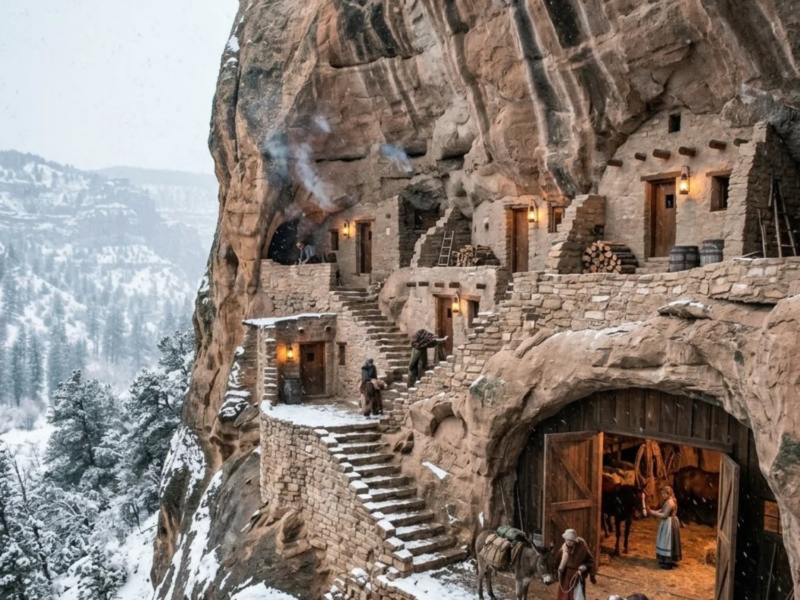
She Built a Barn Beneath a Sandstone Cliff—Then a Blizzard Destroyed Every Other Barn
Confession in the Twilight
Word traveled the way word always travels in a country where wagons pass one another on frozen roads and stop long enough to ask after the news.
By noon of the next day, Robert Whitlock had ridden in on a mule to say his own roof had partly given and he had lost a heifer, and might Mrs. Maddox take his three cows until he could raise a new frame. By evening the Kemps had come, bringing four cows and a nervous saddle horse. The Ashfords sent word by their eldest son that they were coming with what they had left, which was less than they had begun with.
By the second afternoon after the storm, Harriet’s alcove barn held the livestock of six households, standing shoulder-to-shoulder in stalls made suddenly narrow, breath rising in a single fog lifting to the underside of the natural roof and hanging there like weather of its own making. The barn had been built for four cows; it was holding twenty-two animals of various species, and it was holding them, and it was warm.
The neighbors came with the animals, and the neighbors stayed to help. A roster Margaret Dunore worked out with a stub of pencil on the back of a flour bag divided the labor: four hours on, eight off. The men chopped ice on the spring while the women turned out the stalls, and the older children hauled hay from the loft down to the mangers below.
The alcove began to feel less like a private accomplishment and more like a shared shelter—the way a well used by three families becomes different from a well used by one. Harriet found herself teaching a Whitlock boy how to muck a stall without spooking a cow, telling Mrs. Ashford where the good straw was kept, and answering Silas’s questions about the drilled anchor holes with the plain directness of a person no longer worried about whether her answers would be believed.
On the third evening of the shared work, Silas Dunore came to find her. She was standing at the door of the barn, watching the last light go pink along the top of the cliff. He came up beside her and did not speak for a while. When he did, his voice was low enough that only she could hear it:
“I owe you a truth, Harriet. I have owed it since February. I could not carry it any further alone.”
She did not turn her head. She had known from the moment his wagon came up the wash on the day the storm broke that this was coming. She waited.
He told it plainly. Bragg had come to him in the fall of the year before Ezekiel’s death, offering money to cut a certain stretch of the Maddoxes’ fence at a certain time so that certain cattle might wander onto certain grass and cause a certain amount of trouble that might, given enough seasons of it, wear a homesteading man down. Silas had refused. He had not told Ezekiel; he had told himself it was a private matter between him and his own conscience, and that no harm had been done because he had said no.
He had gone on telling himself that until the February morning when Ezekiel’s horse had come home without him, and until word had reached the Dunore place two days later that a boy who worked at the Bragg ranch had been seen riding up the wash at first light on the day of the accident, and had come back alone, and had not been seen again since because Bragg had paid him to ride out to California by the end of the week.
Silas had not gone to the sheriff. He had been afraid. He had been ashamed. He had begun instead to ride up the wash every Wednesday and make jokes at a woman he had failed because the jokes were easier than the truth, and because if she failed on her own, then the guilt he carried would have a place to lay itself down.
He finished. He did not look at her; he looked at the last color leaving the top of the cliff. “I do not ask you to forgive it, Harriet. I ask you to know it. That is all I have the right to ask.”
She was quiet a long time. When she answered, her voice was steady, though something in her chest had begun to tremble in a way that had nothing to do with cold:
“Mr. Dunore. My husband left me a note in his chest before he died. Four words in pencil. The name of the man you have just named, and the words do not trust. Ezekiel knew. He did not know how much, but he knew. What you have told me tonight is the shape of what he suspected.”
She turned then and looked at him. His face in the last light was the face of a man who had already served a sentence longer than any court would have handed him.
“I will not forgive it tonight. I do not know when I will. But I will use it. On the fifteenth of January in Prescott, I will use every word you have said to me, and you will say them again before a judge, and Cornelius Bragg will learn what it costs to laugh at a woman who has already built a wall against a mountain.”
He nodded. He did not speak. He walked back toward the cabin where Margaret waited with a cup of coffee for him, and Harriet stood at the barn door until the stars came out one by one above the rim.









