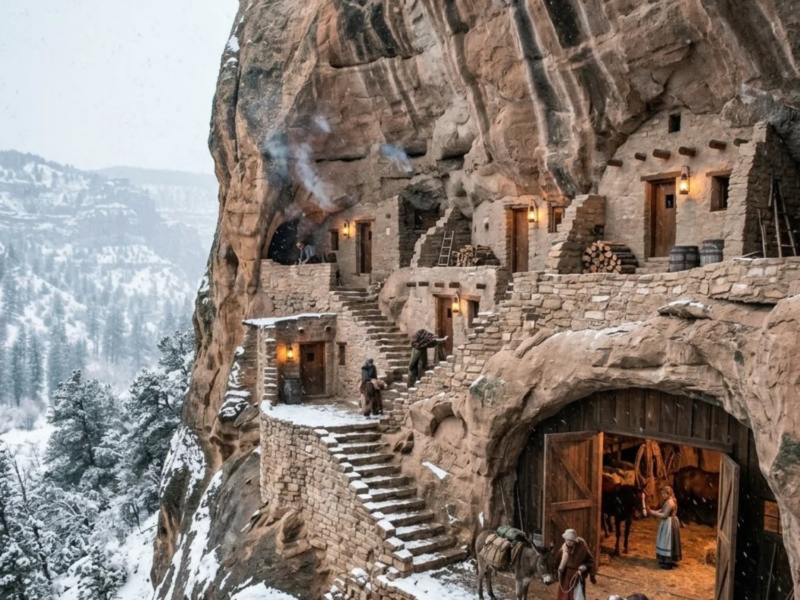
She Built a Barn Beneath a Sandstone Cliff—Then a Blizzard Destroyed Every Other Barn
The Ledger in the Chest
That evening, after Wesley slept, Harriet did something she had not done since the day of the funeral. She opened the small pine chest her husband had kept at the foot of the bed. She had left it closed for six months, unable to face what might be inside it, unwilling to reduce him to the ledger of what he had owned.
Now she lit the second lamp, lifted the lid, and set out the contents on the table one item at a time: his good razor, a tin of tobacco he had never finished, a folded shirt she had made him the winter before he died, still creased where her iron had left it.
Beneath the shirt lay a small notebook bound in oilcloth, and beneath the notebook lay a scrap of paper folded twice. She unfolded the scrap. His handwriting had never been elegant, but it had always been legible, and the words were legible now. Four words in pencil, pressed hard enough to have almost torn the paper:
See Bragg. Do not trust.
No date, no context, no explanation. She turned the scrap over and found the reverse blank.
She sat with it a long while. The second lamp burned lower; outside, the cottonwoods moved in the night wind and made their river sound. She thought about the way Ezekiel’s horse had come home. She thought about the country where he had died—a place he knew as well as his own kitchen, on a slope he had ridden a hundred times. She thought about the fence he had mended twice that winter after finding it cut in ways that did not look like weather. She thought about a pale-eyed man in a good coat and a smile that had rehearsed itself in a mirror.
She did not let herself think further than that. She could not afford to. There was no sheriff who would ride out on the strength of four penciled words, and no judge who would hear a widow’s suspicion against a man who paid tax on 8,000 acres. She folded the paper again, put it inside the notebook, and tucked the notebook inside her own trunk under the linens where she alone would find it.
She lay awake past midnight as the stars wheeled above the smoke hole and Wesley’s breathing rose and fell in the loft. She thought of the alcove and the spiral scratched into its back wall. And she thought of her father in his shop in Harrisburg, saying that a person who sets out to build a thing must first believe the thing already exists and must only be uncovered from the stone, or from the wood, or from the time it lives in.
She turned onto her side and closed her eyes. Tomorrow she would swing the hammer again, and the day after, and the day after that. She would not stop until the roof was over her animals, the wall was between her son and the wind, and every neighbor who had laughed at her had come in one way or another to understand that she had not been laughing back.









