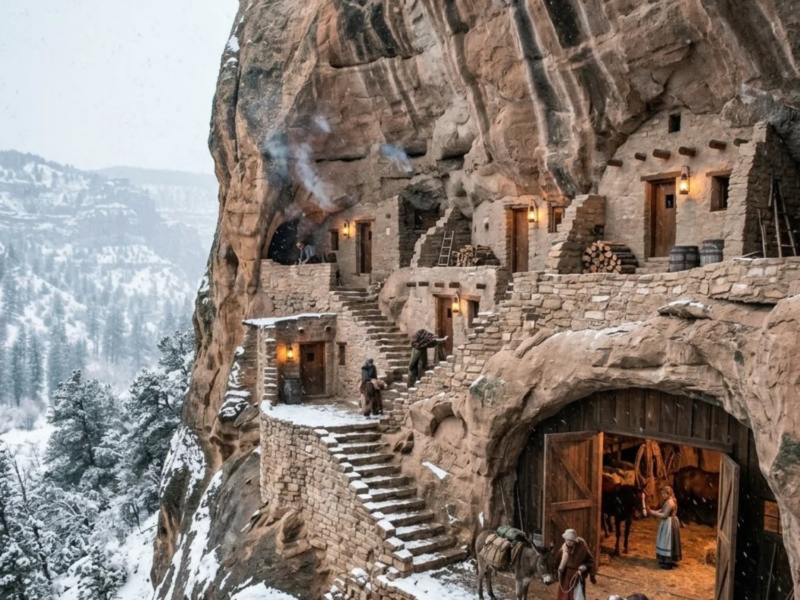
She Built a Barn Beneath a Sandstone Cliff—Then a Blizzard Destroyed Every Other Barn
The Falling Log
The fourth beam went up on a Friday, and it was the beam that nearly took her son.
She had rigged the tackle to the same cottonwood. The log was the longest of the eight—twenty-two feet—and its weight was distributed poorly because the taper of the pine had been steeper than she liked. She had noticed the fray in the rope’s middle two days before and had told herself she would splice it before the next raise. She had not spliced it. She had been at the mortar box past dark, and by the time she came in, her hands would not hold a needle for the shaking.
When she came out at dawn, she looked at the rope, saw the fray, and made the decision a person makes when tired: It will hold this one more time. It will hold.
Wesley had asked that morning to work the tail of the fall. He had done it three times before under her eye; he was proud of the callus on his little finger from the last raise. She had said yes. She had been thinking about the angle of the log, the depth of the wedge holes, and the way the beam would want to swing as it cleared the halfway point, and she had said yes without thinking about the rope.
They had the log a third of the way up when she heard the sound. It was not a snap. It was a sigh—a soft breath of failing fiber—and it came from the point where the rope crossed the pulley overhead.
She was already turning when the rest of it went.
The log dropped: twenty-two feet of green pine, four hundred pounds, falling nose down toward the alcove floor. Wesley stood at the tail of the rope with the slack suddenly loose in his hands, his face turned up to watch the beam he had been lifting a heartbeat ago. He did not understand yet what was happening. She saw the understanding beginning in his eyes and knew he would not move in time.
She was already moving.
The distance between them was six feet. She covered it without breathing and hit him with her shoulder the way a man hits a door he means to break down. They went together across the packed sand as the log struck stone.
The sound the log made when it hit was a sound she would hear in her sleep for the rest of her life. It was not the sound of wood; it was the sound of a mountain being reminded that it could be struck. The impact threw grit into the air in a plume that hung there and would not settle. The log rolled once, twice, and came to rest against the near wall with its splintered end pointing at the sky. Two feet from where Wesley had been standing, the sandstone floor was cracked in a star pattern the size of a dinner plate.
She did not move for what felt like a long time. Wesley did not move either. She could feel his heart against her arm running so fast it seemed impossible a body that small could pump so much blood at once.
When she lifted herself off him, she checked him with her hands methodically—ribs, collarbone, legs—the way she would have checked a horse after a fall. And only when she had assured herself that he was whole did she permit herself to sit down on the ground beside him.
He looked at her. His face was gray under the freckles; his mouth trembled. Then it opened, and what came out was not a sob, but the sentence a child says when he has understood something a child should not have to understand:
“I am sorry I asked you to build it, Mama.”
She pulled him against her chest. She held him with both arms—harder than she had ever held anything—and spoke into his hair with a voice she barely recognized as her own:
“You did not ask me to build it. You asked me if it was possible. Everything since has been my answer.”
She held him until his heart slowed. She held him until her own did. When she stood, she did not shake. She walked to the log. She examined the rope where it had failed. She untied the tackle, coiled the rope, walked to the cabin, and took down from a nail above the door the second rope—the good rope, the one Ezekiel had bought in Prescott and never used, the one she had been saving for a reason she could not have named until that moment.
She spliced nothing. She used the good rope. She raised the beam that afternoon without help, using the mule and a longer purchase, and she did not permit her son inside the alcove until it was set. When it was set, she called him in, lifted him up so he could touch the underside of the beam with his palm, and told him that this beam belonged to him now—that it would hold up the roof under which his own children would one day feed their animals, and that a man who has set a beam has a claim on it forever.
He nodded against her collarbone. He did not cry. That was the last time either of them mentioned the fall.









