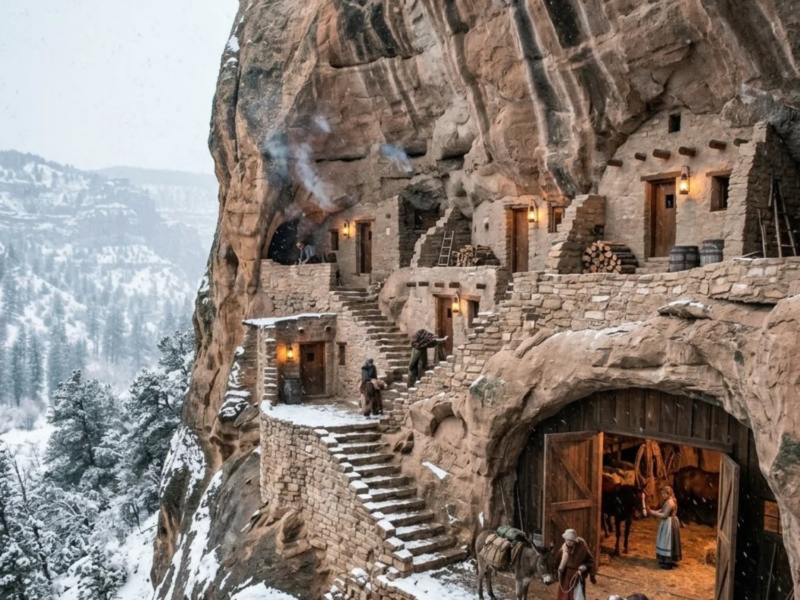
She Built a Barn Beneath a Sandstone Cliff—Then a Blizzard Destroyed Every Other Barn
The Country Remembers
Bragg did not last the year.
The word of what had been said in Judge Harden’s courtroom traveled the way word traveled in that country, and the small ranchers who had grazed their cattle at his sufferance began one by one to make other arrangements. Two of his foremen left him in the spring. His bank in Prescott, which had been carrying his notes on the strength of his reputation, called in a portion of them in the summer, and he sold four thousand acres to meet the call.
By the following winter, he had put the remainder up for sale, taken the train to San Francisco, and the country never saw him again. Silas Dunore’s testimony was never used in a criminal court because the boy who had ridden west from the Bragg ranch was never found, and because the sheriff of Yavapai County was a cautious man who did not open matters he could not close.
But the country remembered. The country always remembered.
Spring came late that year; the last snow fell on the eleventh of April. By the first week of May, the wash was green again, the cottonwoods had put out their small new leaves, and the neighbors began the work of rebuilding what the storm had taken.
Silas Dunore built his new barn against the south face of the ridge behind his cabin, its back wall dug three feet into the slope and banked with earth. Robert Whitlock built his of mortared stone with a shallower roof pitch than he had used before. The Kemps came to Harriet twice a week for a month asking questions; she answered patiently, and the barn they raised in June was half of stone and half of timber and stood the winter that followed without complaint.
Word of the alcove barn traveled beyond the county. In July, a family from up near the Little Colorado rode down to see it. In August, a man from the land office in Santa Fe wrote her a letter asking if she would be willing to correspond with him about her methods, and she wrote him back in the plain hand her father had taught her.
She did not build another barn. She had built the one she needed, and the country did not need a second from her hand. What the country needed from her, she came to understand, was her presence at other people’s raisings: her eye on other people’s anchor holes, her voice at the mortar box saying, Add a little more lime. That is too wet. That is right.
She gave what she was asked to give. She refused nothing. She charged nothing. She had learned in the six months between February and August of 1887 that a thing built alone is a private victory, and a thing taught is a public one—and only the second kind lasts past the life of the builder.
One evening in the middle of that first spring after the trial, she sat on the bench outside the cabin with Wesley beside her. The sun was going down behind the western rim of the wash, and the light along the cliff face had turned the color of a good copper pan. Wesley had grown two inches since Christmas; his voice had begun to do the thing a boy’s voice does at eight, cracking sometimes on the last word of a sentence in a way that made him blush.
He asked without preamble the question she had been waiting for him to ask: “Do you think Papa would be proud of us, Mama?”
She thought about it. She did not answer quickly, because he deserved an answer thought about. When she spoke, she chose her words the way she had chosen the stones in the top course of the wall, one at a time for fit:
“Your father would be proud that we lived through it. He would be proud that we found a way when there was no way to find. He would be proud that we did not sell.”
She paused, looking at her son, and said the last part more slowly than the rest: “But I think he would be proudest that we opened the door when the neighbors came. A person who builds only for herself has built a small thing. A person who builds so that others may shelter with her has built something the country will remember. Your father would know the difference. He would want you to know it, too.”
Wesley was quiet a while. Then he said: “Will we build another one somewhere else, Mama? A barn like this one?”
She smiled and shook her head. “No. One is enough for what we need. But if someone asks us to help build theirs, we will go. That is what neighbors do.”









