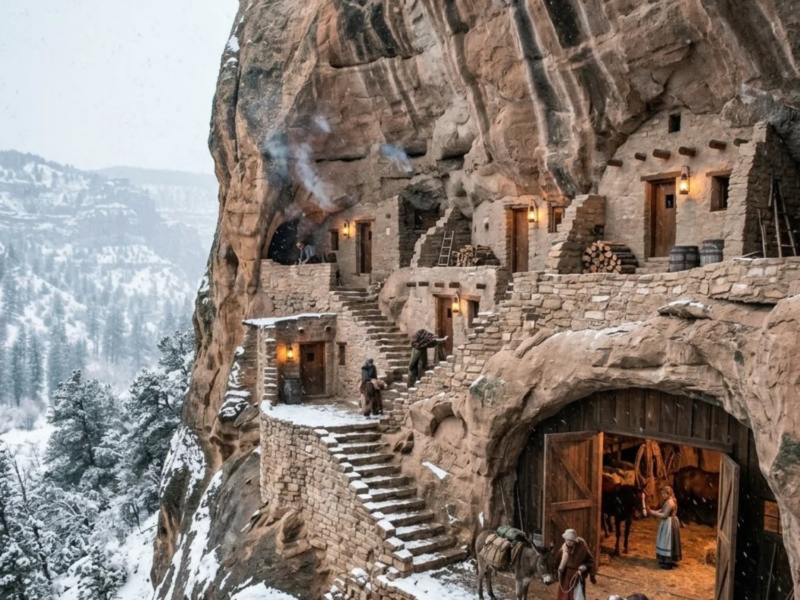
She Built a Barn Beneath a Sandstone Cliff—Then a Blizzard Destroyed Every Other Barn
The Proof
The storm arrived on the twenty-second of December, and it arrived the way a bull walks into a pen it has decided to own. There was no preamble worth naming: a morning that broke gray at noon, turning the sky the color of wet slate, and at three o’clock the first heavy flakes began to fall in sideways sheets that erased the road before the boots of a person walking on it could leave a print. By dark, the wind out of the north had risen to a note Harriet had never heard from that country—a low, sustained howl running the length of the wash and back again. The thermometer on the north wall of the cabin had dropped past zero at supper and was still falling at bedtime.
She had brought the animals into the barn two days before. She had done it slowly, without hurry, because animals read the hurry of the people who move them and take fright from what they read. The cows had come first, and the mule had followed the cows because the mule followed cows in all weather, and the pigs had come last with a great deal of complaint that made Wesley laugh for the first time in a week. She had filled the loft to the beams, topped off the water troughs from the spring, and banked a second layer of straw across the drainage channel to trap warmth against the floor. She had shut the door, pulled the wooden latch, and walked back to the cabin through the first fat flakes with a tightness in her chest that was not fear, but its close cousin.
The first night of the storm, she did not sleep. She fed the fire in the cabin hearth every hour by the small clock on the mantel because a fire that goes even a little cold in weather like that will not come back without a fight, and a fight was not a thing she could afford to lose while a boy slept ten feet above her. Wesley woke twice from the sound of the wind and came to the ladder to look down at her, and each time she smiled up at him and told him to go back to bed, and each time he did because he had learned to trust her voice against the noise the world made outside their walls.
Toward morning, she rose from the rocker with her joints aching and cracked the shutter an inch to see what the country had become. The wash was gone; the cottonwoods were gone. There was only white moving—endless white—and beyond the white, the sound of a wind that had forgotten it had ever done anything else.
On the second morning, she dressed in every layer she owned: Ezekiel’s old coat over her own, his scarf, the mittens Margaret Dunore had knit her the winter she came out from Pennsylvania. She took the shovel from beside the door, told Wesley to keep the fire high and wait for her word, and went out into the snow to reach the barn.
It was forty steps. It took her nearly an hour.
The drifts against the north side of the cabin had risen past the windowsill, and once she was clear of the eaves she was in it to the top of her thighs, breaking a path one plunging step at a time. Twice she stopped because her breath had begun to freeze inside her scarf and she had to pull the wool away from her mouth to keep from smothering. Once she looked back and could not see the cabin, and a small, clean threat of terror went up her spine before she reminded herself of the compass in her head and pushed forward.
The barn door had shed most of the snow because the alcove itself sheltered it. She lifted the latch; the wood had swelled slightly with the cold and stuck. She put her shoulder against it. It gave.
She stepped inside, closed the door behind her, and the wind cut off as if a hand had been laid across a mouth.
The silence inside was the first thing. Then the warmth—not warmth in any human sense, but the absence of the wind’s teeth, an absence so profound that her cheeks began to burn as the blood came back to them. Then the smell: cows and hay and old wood, the smell of a barn on any morning in any country where a barn is a barn.
The animals turned their heads to look at her. The mule made his low huffing sound. Bess’s daughter—the younger cow, now grown into her mother’s role—moved a step forward in her stall in the calm way an animal will greet a person it has decided is safe.
Harriet stood in the doorway with her hand still on the wood, and she took the truth of it into her body before she permitted her mind to say the words: The rock had held. Not because rock was warm—rock was not warm; rock could not be warm. The truth was in the ground and in the mass of stone curving above and behind and around, and in the way the whole earth on that side of the alcove refused to conduct the killing cold as fast as it fell. The wall she had built was two feet of stone at its base, and the mountain was a mile of stone behind it, and the drifted snow now piled outside the door was itself a blanket. The storm had laid over its own weapon. The animals were making their own heat with their bodies, and the barn was letting that heat linger the way a well-made pot lets a fire linger under a soup.
It was not magic. It was engineering as old as human beings, and it was working exactly as she had believed it would.
She checked the water—it had a skin of ice at the surface she broke with her hand. She forked fresh hay into each stall. She stood a moment longer in the doorway to burn the picture into her memory, and then she went back out into the storm.
On the walk back to the cabin, she permitted herself for the first time in six months to laugh out loud. The sound was ugly and torn and immediately swallowed by the wind, but she heard it inside her own head, and it was the sound of a woman who had begun to believe her son might see April.









