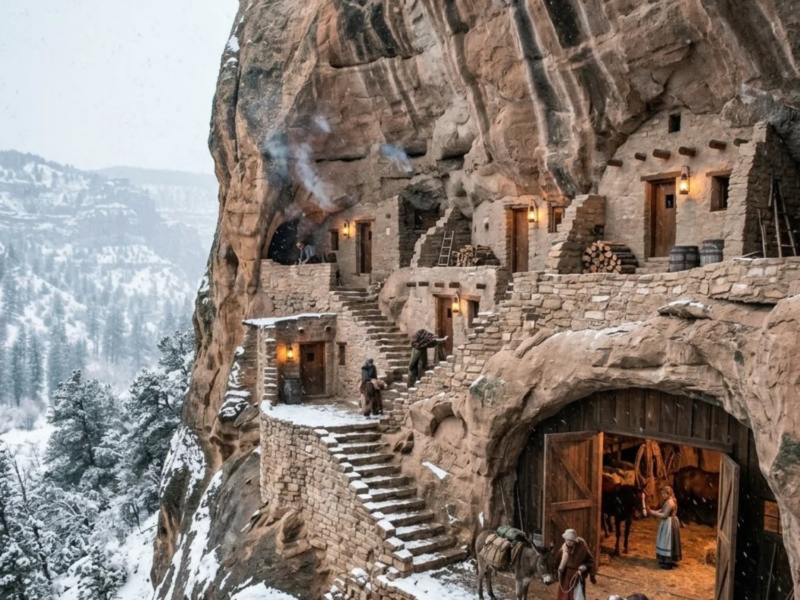
She Built a Barn Beneath a Sandstone Cliff—Then a Blizzard Destroyed Every Other Barn
Shadows in the Rock
“Tell me again, Mama,” he asked her one afternoon under the cottonwoods, dipping a tin cup into the water bucket. His hands were nicked and rusty with iron dust. “Tell me why.”
“Because the animals need a roof before the snow,” she told him. She had told him before; she would tell him again. “Because we do not have money and we do not have help. So we use what we have, which is this cliff and these two pairs of hands.”
He drank slowly. “…And because they say we cannot.”
She looked at him a long while—at the seven-year-old face, already lengthening toward whatever man he was going to be. “That, too. Maybe most of all that.”
The first blistering week, her hands looked like something out of scripture. The second week, they hardened. By the end of the month, when she pulled her gloves off in the evening, her palms had the look of tanned leather stretched too tight over a saddle horn, and she felt nothing at all when she picked up a hot pan by mistake. Wesley’s hands stayed soft where they could and callous where they couldn’t: one on the pad below his thumb from the bucket handle, another along the outside of his little finger from the brush. He never once said his hands hurt. She never once asked. There was a covenant between them that neither named.
One evening late in the third week, Wesley called her over to the back wall of the alcove. He had brushed away a crust of red dust, and beneath it—cut into the sandstone with a patience she could feel through her boots—ran the shallow line of a spiral. Below the spiral, a snake had been pecked into the rock, its body curving with the natural fissure of the stone; above them both was the round of a sun with four small rays.
She knelt beside her son, put her hand on the cool stone, and did not speak for a long time. Someone had been here. Someone had thought this place worth a mark. Someone had sat where she was sitting in the shade of the same overhang and had believed the wall could hold something worth making. The knowledge went into her like a slow drink of water on a hot day. When she rose again, she did not tell Wesley what it had done to her. She only said, so quietly he had to lean in:
“The people who came before us were not wrong.”
Silas came by that Wednesday, as he had come every Wednesday, and drew up his geling a little further off than usual. Something in the way she was working that afternoon had put an edge in the air, and he seemed to feel it without knowing what it was. He offered his usual advice in his usual tone, but she did not answer, did not look up, did not slow. When he had ridden off, she realized her cheeks were wet, and she was surprised because she had not thought she had tears left in her for a man who meant her no harm and only pity.
The next visitor was of a different kind entirely, and he did not come laughing.
Cornelius Bragg drove himself up the wash in a black surrey with red wheels—the sort of rig that announced money before its owner opened his mouth. He was a heavy man in a good coat, clean-shaven in a country of beards, with the pale eyes of a man who spent his life doing sums in his head. He ran the largest outfit in three counties: 8,000 acres of grass, leased or owned outright; 400 head that in a dry year could climb to 500. Everyone within a week’s ride knew his name. Everyone knew the way his hand closed around a piece of country and did not open again.
He drew up in front of the cabin and did not step down until Harriet came out to meet him, wiping her hands on her apron and setting her shoulders the way her father had taught her to set them at market. He removed his hat with courtesy. His smile was the smile of a man who had rehearsed it.
“Mrs. Maddox, forgive the intrusion. I have been meaning to pay my respects for a good while now, and business has kept me from doing it as promptly as a decent neighbor should.”
His voice was pleasant in a way that made her count the buttons on his coat instead of listening to the words. He offered condolences for Ezekiel that were correctly worded and empty as a dry well. Then he came to the reason he had come.
He wanted her water. He didn’t use the word water; he talked about the difficulty of a widow’s life on a hard claim, about the kindness of a fair price offered before the winter turned everything into a question of survival, about the peace of mind she and the boy would find in a proper town among her own kind.
He named a figure. It was less than a third of what the land was worth, and less than a tenth of what the spring alone would have brought a man like him over ten years of grazing his herds down the wash. He said it with the smile of a man doing her a favor.
She did not raise her voice. She did not step back. “The land is not for sale, Mr. Bragg.”
His smile did not move at first. Then it did, and what came into it was the thing his eyes had been hiding. “Mrs. Maddox, you will change your mind before the spring. A woman alone in a canyon like this learns before long what the country will and will not permit. I only hope that when you come to me, my offer has not had to grow smaller for the waiting.”
He put on his hat. He turned the surrey with the practiced hand of a man who had turned many surreys in many yards, and he drove away without looking back. The dust of his wheels hung in the road a long time after his rig had vanished around the bend.









