She Built a Barn Beneath a Sandstone Cliff—Then a Blizzard Destroyed Every Other Barn
The Language of Tools
To understand why she stood there at all, one has to go back two years to a coal-smoke street in Harrisburg, Pennsylvania, where a carpenter named Josiah Ren kept a shop that smelled of pine shavings and linseed oil.
Harriet had grown up on the plank floor of that shop with a lap full of dowels, sorting them by diameter while her father talked to himself about grain and season and the way a green board would betray you if you rushed it. He had no sons. He had her. So he taught her the language of tools the way another father might have taught his boy his letters: feather and wedge, story pole, scarf and rabbet. She could set a mortise before she could set a table. When she married Ezekiel Maddox at nineteen, her father wept—not for losing her, but because he had seen the West in Ezekiel’s eyes and known she would follow it.
They followed it in the spring of 1885. Ezekiel had read a pamphlet from the land office promising 160 acres to anyone with the will to hold it, and the Arizona territory had answered some hunger in him that Pennsylvania could not fill. They came by rail as far as the tracks would take them, and by wagon the rest. When they crested the last rise above Coyote Wash and saw the red walls rising on three sides around a strip of green, Ezekiel had reached across the buckboard and taken her hand without saying a word.
The spring on the eastern wall ran clear, cold, and steady—rarer than gold in that country. A stand of cottonwoods marked its course down the wash, and the grass in the flat was thick enough to lie down in. It was, she had thought then, a place a person could love.
They built the cabin in their first summer: three rooms of squared pine with a stone hearth Ezekiel raised himself. They ran fence. They put up a lean-to for the animals and swore to each other that a proper barn would come the following spring. Wesley learned to ride a mule before he lost his front teeth. In the evenings, Ezekiel read aloud from the two books they had brought, and Harriet mended by lamplight, and the wind in the cottonwoods made a sound like a river always about to arrive.
Then came the February of 1887, the cow that broke fence, and the ride Ezekiel took to bring her back.
What the horse had shied at, no one ever discovered—a rattlesnake perhaps, come out too early from its winter sleep; a shadow; a shot from somewhere he did not think to look. What she knew was that his horse came home without him at dusk, and that she found him a mile up the wash with his head turned wrong against a slab of sandstone. He breathed for three days. He did not wake. On the fourth morning, his breath simply stopped between one moment and the next, and she was left holding a hand that had gone cool as canyon water.
She buried him under the largest cottonwood, and Wesley stood at the graveside without crying because he had already understood that his mother needed his eyes to stay dry.
Six months later, she stood at the base of the cliff with a star drill in her hand because there was no other honest choice left to her.
The animals she had inherited from that marriage were four milk cows, twelve laying hens, two pigs, and a mule so old his teeth had worn to nubs. The lean-to had shed most of its canvas in the July wind. The three loads of pine Ezekiel had hauled from the northern forest sat stacked and drying against the cabin wall, and she had counted the boards more times than she cared to remember. It was not enough for a barn. It was not close to enough.
Buying more lumber would have taken money she did not have, and cutting more herself would have taken a man’s back, a second pair of hands, and a summer she no longer possessed. She had lain awake for weeks trying to find a road through it. Nothing added up. The cows would not last a Coyote Wash winter under canvas; she had heard the stories at church socials, the off-hand mentions of families found frozen when spring came, the livestock stiff as furniture in the drifts. She had watched Wesley eat his supper and known—with a cold that had nothing to do with weather—that she could not carry him through another February by faith alone.
The night the idea came, she had been reading to him from a small blue book a schoolmarm in Prescott had given her, filled with woodcut illustrations of the ancient cliff villages dotting the region. Wesley had put his finger on a picture of a small stone dwelling tucked into an alcove high in a canyon wall, its doorways black as eye sockets, its walls the same color as the rock holding it.
His voice had been careful, the way children make their voices when they suspect they might be asking a foolish thing: “Why did they build inside the rock, Mama?”
She had told him what she knew. The rock kept the weather off. The rock did not burn. The rock did not blow down. Enemies could not come at you from behind if the mountain was your back.
He had considered this a long moment, and then he had said the sentence that would rearrange her life: “Could we build our barn in the rock, Mama, like they did?”
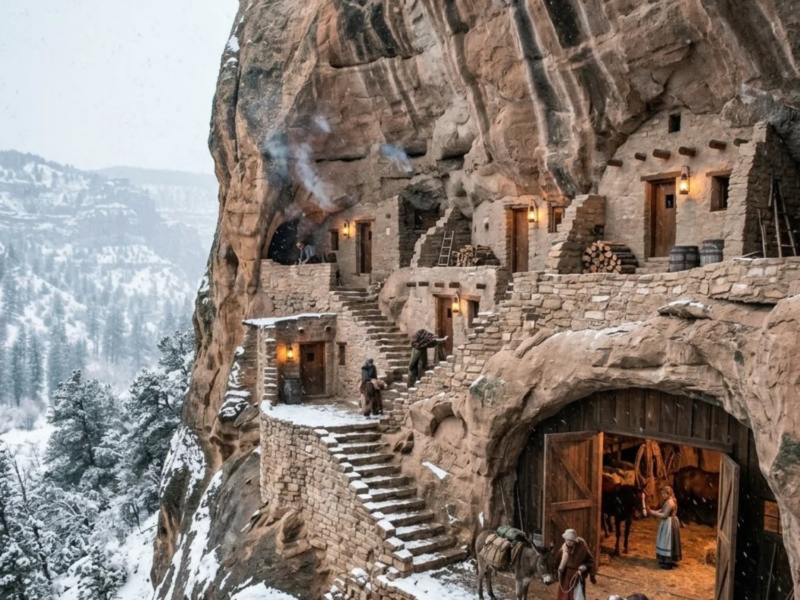
She had not answered him at first. She had looked past him at the door of the cabin, and past the door at the moonlit shape of the canyon wall, and she had seen the shallow alcove she had walked past a thousand times without truly seeing it: fifteen feet deep, forty feet wide, twenty feet high at the crown, sloping down toward the floor—a natural roof of red stone that had shed rain and snow for ten thousand years without complaint.
She had risen from her chair without a word, put on her shawl, taken up a lantern, and walked out into the cold to hold the light up against the alcove’s dark throat. Wesley had followed in his stockings. Neither of them had spoken. She had stood there a long time, and when she turned back to the cabin at last, something in her face had made the boy take her hand as if she were the child.









