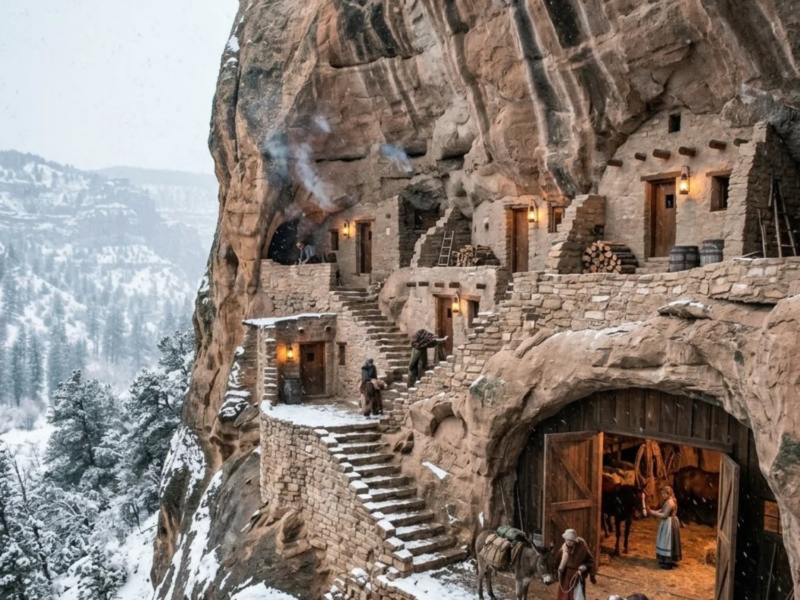
She Built a Barn Beneath a Sandstone Cliff—Then a Blizzard Destroyed Every Other Barn
The Neighbors Return
The wind fell on the fourth day. The snow stopped by midmorning. The sky opened blue as a robin’s egg above a country rewritten in white from horizon to horizon.
She stepped out with Wesley beside her, both of them squinting against the brilliance, and they measured the drifts by walking to them hip-deep in the wash and shoulder-deep against the north wall of the cabin. Wesley let out a whoop that echoed off the cliff. He had been three days indoors; he was seven; he needed the sound of his own voice to be sure the world was still there.
They were shoveling a path from the cabin door to the barn when the wagon came up the wash. It came slowly, its team laboring through breast-deep snow, its driver standing on the box to pick the shallowest line. Harriet did not recognize the wagon until it was very close. Then she did.
It was Silas Dunore’s, and it was Silas driving, and beside him on the bench sat his boy Thomas, twelve years old, wrapped in three coats and a hat that had once been his father’s. Silas’s face was gray; his mustache had ice in it. He pulled the team up at the yard and did not get down. When he spoke, his voice had the exhausted rasp of a man who had not slept in two nights:
“Harriet, our barn is gone. The roof came down under the snow last night. We got the horses clear. Two of the cows are pinned. Margaret and the girls are digging. I could not get through to any other place. I came here because your road was straightest, and because—” He stopped. He looked past her at the barn in the alcove, its door standing open where Wesley had propped it, the animals visible inside: warm, alive, calm.
He looked at it for a long time. Whatever he had been about to say went out of him. What came instead was quieter: “—because I did not know where else to go.”
She did not make him wait for the answer. “Wesley, get my tools. Mr. Dunore, we will follow you. Give me ten minutes to bank the fire.”
They spent the rest of that day at the Dunore place three miles down the wash. The barn had come down at the ridge, the timbers folding inward the way a bad handshake folds a set of fingers. Margaret was in the wreckage to her waist when they arrived, her hair down, a shovel in her hands, digging beside her oldest daughter at the flank of a red cow that was still breathing.
Harriet went in beside her without a word. They worked with pry bars and axes and shoulders and one long piece of oak Silas had cut from a corral rail for a lever. They got the first cow out at dusk; she was bruised bloody along the ribs, but she stood and she walked and she would live. The second cow they did not reach until full dark, and she had died an hour before, and Margaret sat down in the snow beside the animal and cried without sound while her daughter put a coat around her shoulders.
Silas stood a little apart, looking at his hands as if he didn’t know what to do with them. Harriet went to him. She did not touch him; she didn’t need to. She only said, quiet so the others could not hear:
“You will bring your remaining stock to my place tomorrow. All of them. There is room.”
He looked at her, his eyes red from wind and what had risen behind the wind. “Harriet… I do not deserve—”
“Deserve is a word for churchyards, Mr. Dunore. My barn is a word for winter. Bring them at first light.”









