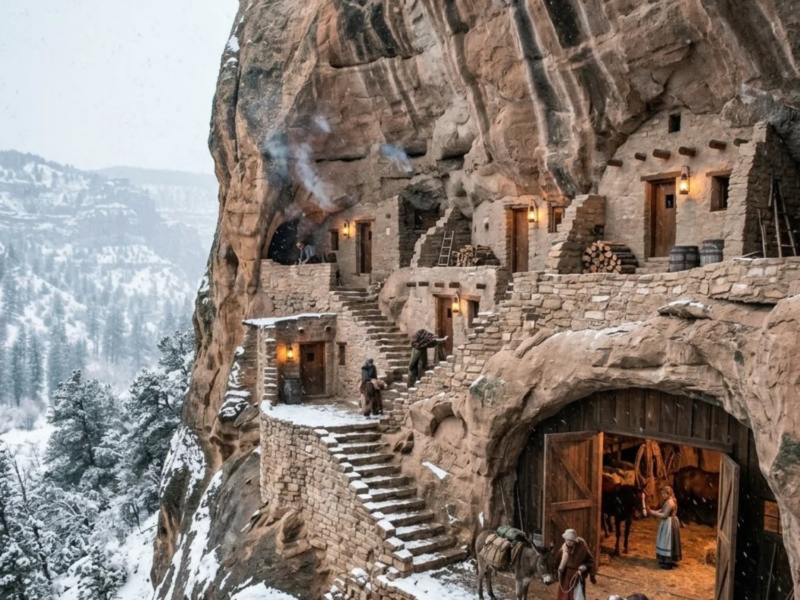
She Built a Barn Beneath a Sandstone Cliff—Then a Blizzard Destroyed Every Other Barn
The Breaking Point
The wall began to rise across the alcove throat on the first of October.
She laid stone from the ground up, working from both ends toward a center, keeping her courses level with a story pole she had cut from cottonwood. She left openings for windows at the height she wanted light. She framed a doorway of good pine, mortised and pinned, and set it plumb with a level she filled with lamp oil each morning because oil settled truer than water in cold weather.
The wall was two feet thick at the base and eighteen inches at the top, leaning back into the alcove half an inch to every foot of rise so that the weight of the stone pressed itself into the mountain rather than away from it. That trick she had taken from a book Ezekiel had bought in Prescott the year before he died—a book on old Roman engineering she had read three times through in the long February nights while he lay dying, unable to bring herself to be idle even at the edge of the world.
Bragg’s men came in the second week of October. She never saw them; she only saw what they left.
The east fence, which she had checked and mended three days before, lay flat in the grass at first light on a Sunday morning, its wires cut cleanly and its posts pulled from the ground. The cows were scattered across a half mile of wash—all but one. The one was Bess: the oldest and the calmest, the cow that had walked to Wesley’s hand for a scrap of biscuit since he was five, the cow whose milk had fattened him through his second winter when Harriet’s own milk had failed.
She found Bess two days later up a side draw where no cow would have wandered on her own, her legs broken in a pattern that no honest fall would have made.
She sat down beside the animal, put her forehead against its warm flank, and did not move for a long time. Wesley stayed behind at the cabin because she had told him to. When she came back, she did not tell him what she had seen; she only said that Bess had died, that they would butcher her before the meat spoiled, and that they would not waste her.
They spent that afternoon at the work no woman on the frontier could afford to refuse. Harriet had killed hogs beside her father in the Harrisburg yard; she had helped a neighbor in the first winter here with a steer that had broken a leg on ice. She knew the knives. She knew the order of the cuts. Wesley did what he could—keeping the fire under the rendering kettle and running for salt when she called for it.
That evening, with the smokehouse hung and the cabin quiet, she sat at the table with her hands still smelling of tallow, opened the pine chest again, took out the scrap of paper, and read the four words a second time: See Bragg. Do not trust.
She did not weep. She did not curse. She folded the paper, replaced it, lay down beside her sleeping son, and stared at the smoke hole until the stars moved a full hand’s breadth across it. She raised the pace of her work by an hour a day after that, not because she felt stronger, but because she felt the country closing in.









