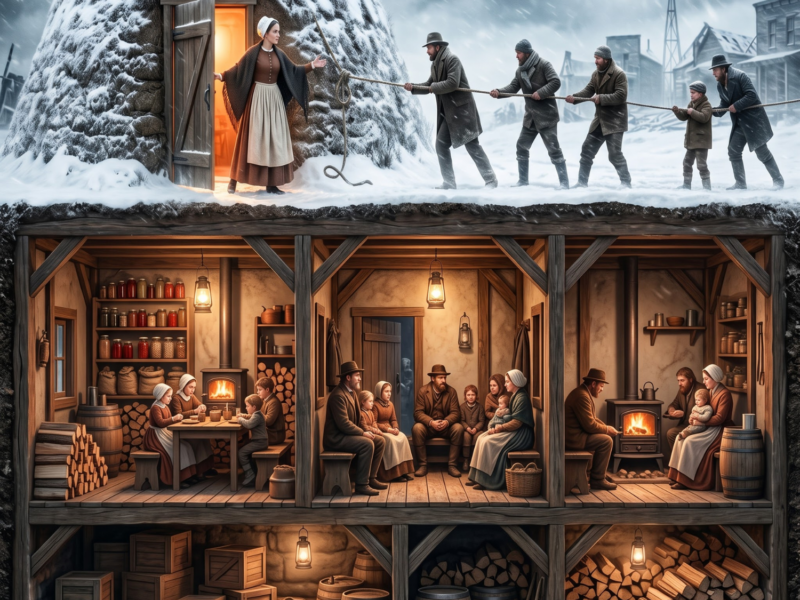
They Mocked Her Sod House—Then a Historic Blizzard Trapped the Entire Town ❄️
They Mocked Her Sod House—Then a Historic Blizzard…
The morning of January 19th, 1884, broke over the Nebraska prairie with a profound, deceptive grace.
It was the kind of warmth that made people forget exactly where they lived. In the settlement of Cedar Flats, the frost finally loosened its iron grip on the split-rail fences lining the main road. Women, their hands red and chapped from the winter’s labor, eagerly threw open windows that had been sealed tight with rags for weeks. Children marched toward the single-room schoolhouse without thick wool scarves pulled up over their mouths, their laughter ringing clear against a sky that seemed to have lost its winter nerve.
Farmers stepped out of their barns, boots crunching softly in the thawing mud, and looked up at the sun with the cautious, suspicious pleasure of men who had survived something brutal and were not yet ready to trust the reprieve.
The prairie exhaled. Every person in Cedar Flats felt the deep, settling relief of it.
Ruth Kalen felt something else entirely.
She stood on the highest point of the rise, half a mile northwest of the town. She was forty-two years old, her heavy boots planted squarely in the frozen yellow grass, a small, worn leather notebook pressed firmly against her ribs. She was not watching the road below. She was not watching the children running to school or the women leaning out of their windows.
Her eyes were fixed dead ahead, locked on the northwestern horizon.
There, sitting incredibly low against the sky, was a line of deep, bruised blue. It was thin enough that a casual observer would miss it entirely, but dark enough for Ruth to understand exactly what it meant. It was not a straggling rain cloud. It was not morning fog burning off the distant hills. It was not a shadow.
She had seen that exact color only once before in her life. The memory of it did not live in her mind as a conscious thought; it lived in the muscle and bone of her body, the way certain traumatic lessons bypass logic and settle deep into the ancient, animal instincts of survival.
She had been sixteen years old when the Sandhills of Nebraska had first tried to kill her.
It was the bitter winter of 1862. She had gone out before breakfast, the sky pale gray but stable, to bring in a stray calf that had pushed through a gap in the wooden fence during the night. It was the kind of morning that offered absolutely no warning. She found the shivering calf in a shallow draw two hundred yards from the house. She had just looped a rope around its neck and turned back toward the glow of the kitchen window when the wind changed.
It did not change gradually. It did not shift with the slow, predictable rotation of a normal weather front. It changed the way a heavy wooden door slams shut in a draft.
One moment the world was open; the next, it went entirely, violently white.
The snow did not fall from the sky above. It seemed to explode upward from every surface at once, lifted by a screaming wind that moved faster than she could process. Within minutes, the ground and the sky became the exact same thing. There was no horizon. There were no shadows. There was no depth to the air.
She walked, dragging the calf, with the absolute certainty of someone who knew exactly where her front door was. She walked for nearly an hour in that terrifying certainty.
She was wrong about every single step.
The cold reached her quickly, slicing through her heavy wool coat, her dress, and the two pairs of thick socks inside her boots. But the temperature was not what frightened her.
What frightened her was the wind.
Each gust stripped the radiant heat from her skin faster than her burning metabolism could replace it. She could physically feel herself being emptied out. Her legs slowed first, turning to heavy lead, and then her thoughts began to slow, the panic fading into a dangerous, lethargic fog. She was sitting down in the snow, realizing with detached horror that she hadn’t consciously decided to sit, when a massive figure suddenly appeared through the roaring whiteout.
It was a man moving fast, bent double against the wind, wearing a buffalo coat so thick it made him look like a beast from a different century.
His name was Walt Prior, an old pioneer who had been running cattle in the Sandhills for thirty years. He dragged her upright without a word of ceremony, leaving the calf to its fate, and pulled her relentlessly into the wind rather than against it. He followed a route she could not see, moving with the unhurried, mechanical confidence of a man who had memorized the shape of the land beneath the weather.
They reached a structure dug deeply into the south face of a low hill. Its entrance was half-buried, barely visible above the snowline. The walls were an astonishing three feet thick, built from massive blocks of prairie sod and packed clay.
Walt shoved her inside and slammed the heavy wooden door.
The contrast was staggering. Inside, the air was utterly, profoundly still. It was not warm, exactly, but it was absolutely motionless. A small iron stove in the center of the dark room held a modest, glowing fire. There was nothing dramatic about it—just a consistent, steady heat that had nowhere else to go.
Ruth sat on the dirt floor, wrapped tightly in a foul-smelling horse blanket, shivering uncontrollably while Walt fed the stove with the disciplined, sparing economy of a man who had done this a thousand times. He did not pace nervously. He did not speak. He simply waited, possessing the deep patience of someone who understood that, in a blizzard, waiting was itself the work.
When the storm finally eased hours later, Walt stood up. He walked to the nearest wall, laid his large, open hand flat against the packed sod, and looked back at her. His voice was gravelly, the voice of someone stating an arithmetic fact rather than offering grandfatherly wisdom.
“The cold don’t hunt people, girl,” he said, his palm pressing into the earth. “The moving air does.”
Ruth Kalen had carried those exact words for twenty-two years. They did not live in her memory as a quaint childhood lesson to be recalled at dinner parties. They lived in her body as a physical law. She felt it every time the wind shifted across the plains. She felt it every time she stood in an open doorway and felt the precious heat rushing past her face toward the outside world. She felt it every time she watched her neighbors stack their winter woodpiles, calculating the desperate mathematics of fuel against the brutal mathematics of warmth.
Temperature could hurt a person. Moving air was the thing that killed them.
Walt Prior had not built his sod shelter for comfort. He had built it to stop the movement. She never forgot the way the air inside that dark room had felt—like something precious and fragile, cupped gently in two massive hands.
Related Articles

They Mocked the Widow’s Dirt Cellar—Then the Freeze Left Every Cabin Cold but Hers Warm
They Mocked the Widow’s Dirt Cellar—Then the Freeze Left Every Cabin Cold but Hers Warm…

A Homeless Veteran and His German Shepherd Inherited a Ridge No One Wanted — 35 Feet In, They Found
Chapter 1 / 7 A Homeless Veteran and His German Shepherd Inherit… A Homeless Veteran…

Neighbors Laughed When He Built A Cabin Inside An Old Barn—Until It Kept His Home 35 Degrees Warmer
Chapter 1 / 8 Neighbors Laughed When He Built A Cabin Inside An… Neighbors Laughed…

His Sod House Had No Woodpile in January – Until the Trains Stopped and the Town Came Begging
Chapter 1 / 10 His Sod House Had No Woodpile in January – Until t……

She Built Her Cabin Over the Woodshed and Never Burned Wet Wood Again
Chapter 1 / 8 She Built Her Cabin Over the Woodshed and Never Bu… She…

The Duke Abandoned Her on Their Wedding Day—Years Later, He Discovered What He Had Lost
Chapter 1 / 7 The Duke Abandoned Her on Their Wedding Day—Years… The Duke Abandoned…

He Wedged a Tiny A Frame Into a Crevice Before Winter and His Family Slept at 75°F While Town Hit
Chapter 1 / 7 He Wedged a Tiny A Frame Into a Crevice Before Win……

He Was Too Old to Ride—So He Bought the Ruined Ranch and Found the Room Behind the Fireplac
Chapter 1 / 5 He Was Too Old to Ride—So He Bought the Ruined Ran……

Settlers Laughed at His Underground Heat Recovery Duct — Until It Kept His Cabin 71°F Warmer
Chapter 1 / 9 Settlers Laughed at His Underground Heat Recovery… Settlers Laughed at His…

A Navy SEAL Built a Home Inside a Mountain—Then His Dog Warned Him Before the Storm
Chapter 1 / 5 A Navy SEAL Built a Home Inside a Mountain—Then Hi… A…