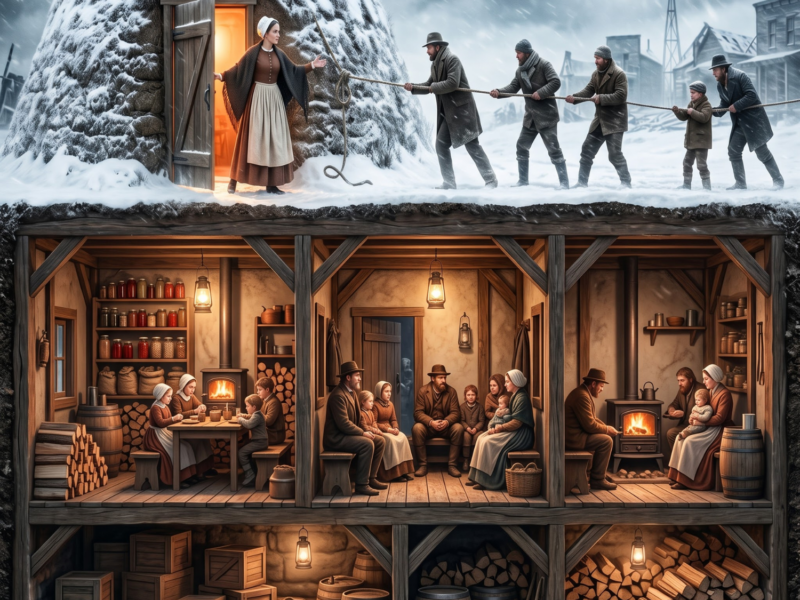
They Mocked Her Sod House—Then a Historic Blizzard Trapped the Entire Town ❄️
The Grave
Construction began in the muddy spring of 1879.
The work did not look like traditional homesteading. To the people who rode out from town to gawk, it looked like something unholy between farming and grave-digging.
Ruth moved methodically across the hillside with a long-handled spade and a heavy wooden cutting guide she had built from scrap lumber. She was carving the top layer of the virgin prairie into massive, uniform rectangles. The sod was incredibly dense with ancient root systems and heavy with packed, black earth. Each block she cut weighed nearly fifty pounds—close to what a full sack of grain weighed. Some, soaked with spring rain, were heavier.
She cut them, pried them free with a sickening tearing sound, and loaded them onto a wooden sled. Bessie, the old dun mule, pulled the sled up the hill in short, agonizingly steady hauls. The mule’s hooves found purchase in the slope with the mechanical, dead-eyed patience of an animal that had long since stopped requiring the work to make sense.
Tom was twelve years old. He was a quiet boy, possessing his father’s steady eyes. His job was water. He carried it from the creek at the bottom of the hill in heavy wooden buckets sized specifically to his arm length. They were not child’s play-buckets; they were working buckets, the kind that left thick, yellow calluses across the soft palms of his hands by midsummer.
He made the trip down the hill and back up so many times that two distinct, thin, parallel tracks were pressed deeply into the grass before July. They were narrow paths worn into the earth by the relentless repetition of a boy doing a man’s work entirely without complaint. By evening, his small shoulders ached with a deep, burning fire that he mentioned to no one. He ate his supper in silence, went to bed, woke up in the dark, and carried water again.
Norah was nine. She was tasked with gathering dry prairie grass. She sorted it into neat, identical bundles beside the work area with the fierce, focused intensity of a child who has decided that what she is doing is a matter of life and death. She did not play during work hours. She did not wander off to chase grasshoppers. She worked tirelessly beside the rising wall, her small, dirty hands moving steadily. And if she noticed the people on the road below who stopped their wagons to point and stare, she gave absolutely no sign of it.
Ruth’s domain was the mixing pit. She dug a shallow depression near the build site and lined it with scavenged wooden boards. Here, she mixed the raw materials of their fortress: clay, water, and chopped grass. She worked the heavy, viscous mixture together with a flat wooden paddle until it reached the exact right consistency. Neither too wet nor too dry—a crucial standard she held by touch and muscle memory rather than exact measurement. The wet clay stained her hands a permanent rust color and dried in the deep creases of her knuckles. She mixed it every single day for months, her back aching constantly.
The hill became a place of punishing repetition. It was the way a good farm becomes a place of repetition—not because nothing ever changes, but because the massive thing being built requires the exact same grueling motion, performed correctly thousands of times, before it finally reveals what it actually is.
By midsummer, travelers on the main road below had begun to slow their horses automatically when they passed the hill. They slowed the way people slow near a terrible wagon accident or a bizarre spectacle.
By autumn, some townspeople were making specific, intentional detours just to look.
The structure on the hill was not finished, but it was already highly visible. Thick, impossibly dark walls were rising from the hillside. They were too massive for an ordinary house, too deliberate and geometric to be a ruin. It was something that fiercely resisted the architectural categories people had available in their minds.
A few visitors rode up and looked at it with genuine, open curiosity. Most, however, just laughed.
The laughter was the comfortable, cruel kind. It was the specific kind of laughter that comes from seeing something deeply unfamiliar and actively choosing loud mockery over the much harder, quieter work of wondering whether you yourself might be wrong.
Harlon Briggs chose mockery with particular enthusiasm.
Harlon was the owner of Cedar Flat’s largest and only general store. He was the man through whom most of the settlement’s credit and debt flowed. He was not a cruel man by nature, but he was highly social, very loud, and entirely accustomed to being the person whose opinion organized and validated the room.
One late summer afternoon, Harlon stood on the boardwalk outside his store, flanked by four farmers who had nothing urgent to do. They watched Ruth’s tiny silhouette moving slowly along the top of the rise, laying heavy black blocks in the fading orange light.
Harlon’s face arranged itself into an expression of amused, absolute certainty.
“She’s not building a house up there, boys,” Harlon announced, his voice carrying down the street.
The men around him waited, grinning. Harlon let the pause stretch out, enjoying the theatrical timing of a man who already knows the punchline is going to land.
“She’s digging her family’s grave before winter even bothers to do it for her.”
The laughter came fast and loud.
By the following Sunday, Kalen’s Grave had become the official, accepted name for the structure on the hill. It traveled through Cedar Flats the way only the right kind of vicious joke travels—effortlessly. It gathered momentum, attaching itself to every single mention of the project. People who had never even seen the hill used the name. Children playing in the dirt used it. The reverend’s wife used it at a church quilting circle, which meant the name had achieved a kind of holy permanence.
Tom heard it first at the schoolhouse. A group of older boys, who had nothing invested in the cruelty beyond the sheer pleasure of inflicting it, cornered him by the pump.
“How’s the grave coming, Kalen?” one sneered. “Your mother figure out she’s burying herself yet?”
Tom looked at them, his fists clenched, but he walked home without answering.
Norah heard it at the feed store. Two women were gossiping near the flour barrels, completely unaware that the small girl was standing close enough behind a stack of grain sacks to catch every single word. Norah carried the insult home inside her chest like a heavy stone she had swallowed.
Neither child mentioned the name to Ruth. They didn’t have to.
Ruth found out through the ordinary, porous channels of a small town. A lowered voice at the post office that wasn’t lowered quite enough. A pitying expression on a neighbor’s face that told the entire story before the neighbor’s mouth could even catch up with it.
Ruth absorbed the information without a single visible reaction. Her face remained a mask of stone.
That evening, after a silent supper, she sat at the rough wooden table. She opened her leather notebook and wrote for significantly longer than usual. Tom, lying in his cot and not yet asleep, heard the furious, rapid scratch of her pencil in the dark. He lay perfectly still, listening to it, afraid to breathe.
In the morning, he woke before dawn to find the cabin empty.
He walked outside. Ruth had placed a single, glowing oil lamp at the base of the unfinished east section of the wall. She was standing in the freezing pre-dawn air, measuring the massive wall with a length of knotted hemp rope, her face set in absolute concentration.
Tom, dressed hastily in the dark, walked out to the site without being asked. He picked up a heavy, damp sod block from the nearest stack, staggered under its weight, carried it to the wall, and set it firmly into place.
Ruth looked at him once. She said nothing. He said nothing. They worked side by side in perfect rhythm until the sky lightened enough to see without the lamp.
In her notebook entry for that morning, written late that night by candlelight, Ruth recorded exactly two words to summarize the day.
Wall progressed.









