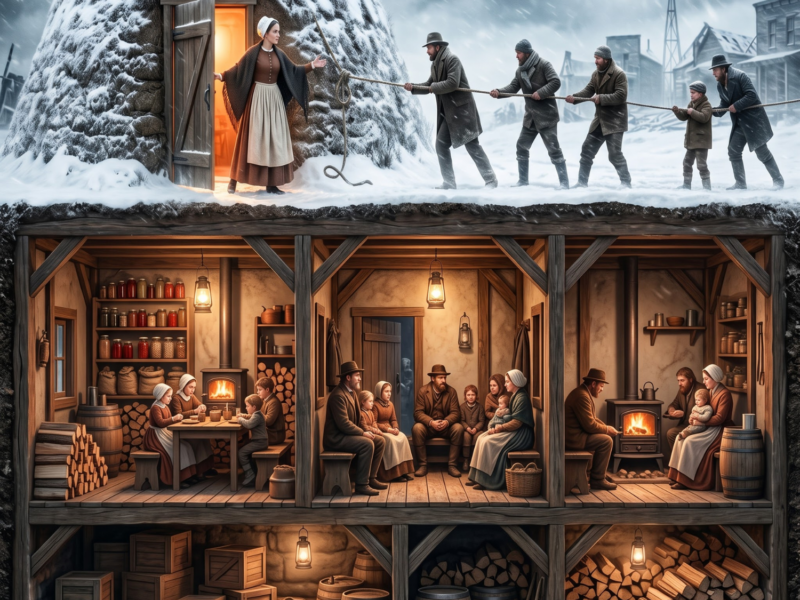
They Mocked Her Sod House—Then a Historic Blizzard Trapped the Entire Town ❄️
The Light on the Hill
The true test of Harlon Briggs’s convictions happened on a still, freezing afternoon in late October, 1883.
Ruth had been thinking about it for some time. She had constructed the test in her mind, the way she constructed everything: starting from the specific, vital question she needed to answer, and working backward to the absolute simplest method of answering it.
The question was whether the air inside the completed structure, after a full year of punishing use through all four extreme seasons, still behaved exactly the way her physics predicted it would. A structure is not a static object. Organic materials expand and contract with moisture cycling. The massive weight settling changes the wall geometry incrementally over time.
She needed to know, beyond a shadow of a doubt, whether the building she had finished in 1882 was still, in late 1883, the perfectly sealed building she had designed.
She set four glass oil lamps in the massive main room, placing them at specific positions near each of the four walls. She lit them as dusk fell.
She had asked Ezra Holt to be there. She had asked him specifically because his ruthless credibility as an objective observer was the only kind of validation that would mean anything to her. She wanted a witness who would not politely confirm what she wanted to see, but would brutally report what was actually there.
Ezra stood near the dead center of the room, his arms crossed, watching while the lamps settled into their burns.
The smoke from each flame rose toward the ceiling in columns that were almost perfectly, unnervingly vertical.
In literally every other building in Cedar Flats, the pressure differential created by freezing air leaking violently through imperfect seals and warped boards would have pulled those fragile smoke columns aggressively sideways toward the nearest gap. The smoke would have traced a visible, undeniable map of the building’s structural failures.
Nothing pulled Ruth’s columns sideways.
The air in the room moved only through the designed upper channels, at the exact, designed rate. The precious warmth produced by the four small flames stayed trapped in the room where it was produced, rising to the ceiling and settling heavily into the massive sod walls, rather than escaping toward the freezing outside world through a hundred small, invisible betrayals.
Ezra moved silently through the room while the lamps burned. He stopped at each one and watched the smoke intently for several minutes. He checked the hidden ventilation channels with a wet finger. He examined the critical joint where the heavy roof structure met the top of the walls—which was exactly where most buildings in the region showed their absolute worst, most lethal air infiltration.
He found absolutely nothing that contradicted the evidence the vertical smoke columns were providing.
When he finally stood completely still in the center of the room, looking at all four burning lamps at once, his silence had a radically different quality than his usual, working silence. It was the profound silence of a man who has completely stopped looking for a problem, because he has accepted that the problem is not there.
Ruth did not speak. She let the brilliant test speak entirely for itself.
Outside, the autumn wind moved violently across the prairie in the way it always moved—without restraint, without direction. It did not choose paths for itself; it violently tested every single surface it encountered, searching for a way in.
Inside the fortress, the lamps burned perfectly straight.
Harlon Briggs came incredibly close to changing his public position in the first days of November 1883.
The story arrived at Ruth’s awareness secondhand, through Ida Crane, who had heard it from two different sources and considered it reliable enough to pass along in hushed tones after church.
Harlon had been locking up his store on a freezing Tuesday evening when he happened to look through the west window. He saw a light burning on the distant hill. It was not the ordinary, solitary light of a household settling in for the night. It was the specific, brilliant configuration of multiple, intense lights inside the structure—which he later learned had been Ruth’s smoke test.
He stood frozen at the window for a very long time. One of his young employees, a man named Peters, found him staring out into the dark and asked whether something was wrong.
Harlon snapped out of it, told the boy nothing was wrong, continued looking at the lights on the hill for another full minute, then violently pulled down the blind and went upstairs to his quarters.
The very next morning, Harlon mentioned casually to no one in particular near the stove that he had been actively considering whether the “mud-hut” construction technique might actually be worth examining for some of the new storage buildings on the exposed south side of his property, where the wind came howling off the flat land and drove his heating costs up astronomically every winter.
He said this in a carefully modulated tone that specifically avoided connecting the idea to the woman who had already built with sod nearby.
Two men in the store heard him. One of them nodded, thoughtful. The other, within the hour, had eagerly told someone else in the saloon that Harlon Briggs was thinking about building a sod shed.
This gossip came roaring back to Harlon by the afternoon, stripped of all its nuance and context, carrying the loud, mocking implication that the wealthiest man in town was copying the crazy widow on the hill.
Harlon, terrified of being the butt of the joke he had started, shut down the idea entirely at supper that evening.
The next day at the store, when Kalen’s Grave came up in conversation, his booming laugh was back at full volume. “Survived one full winter, maybe it’ll survive another,” Harlon chuckled loudly. “Let’s see what happens to the mud pile when it gets a real test.”
The two men who had been there the morning before exchanged a knowing glance that Harlon did not miss. He minded that glance far more than he would have ever predicted. The gap between what he privately knew to be true, and what his pride forced him to publicly maintain, had grown slightly wider. And gaps of that kind have a terrifying tendency to become unbearable at unpredictable moments.









