They Mocked Her Sod House—Then a Historic Blizzard Trapped the Entire Town ❄️
The Silent Room
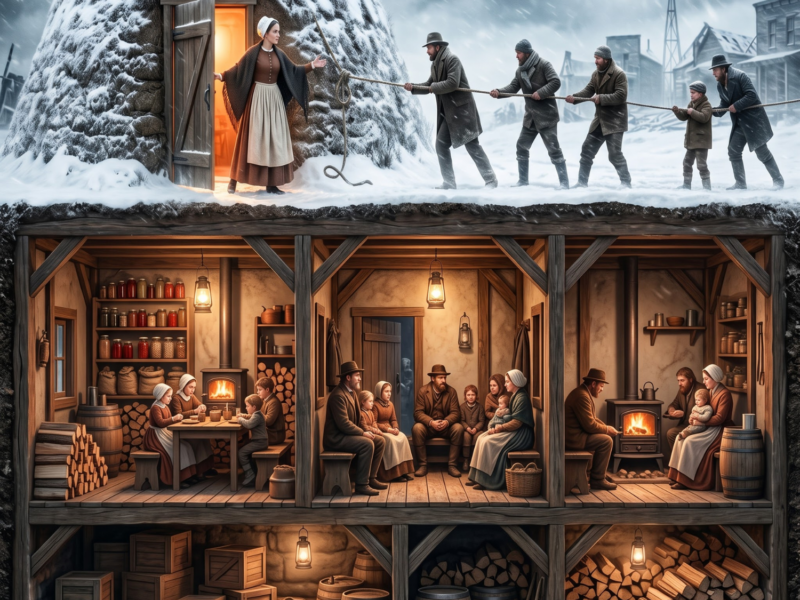
By midnight, the earthen structure on the rise held fifty-one people.
The main room was shoulder-to-shoulder, packed in the way of a space that has been asked to drastically exceed its design capacity without exceeding its structural one. It was crowded, sweltering warm, and loud with the murmuring sounds of people who have recently been terrified out of their minds coming gradually back to themselves.
The east wing had been thrown open and filled. The extra floor space Ruth had built years ago without explaining to anyone was now performing exactly the life-saving function she had built it for.
Norah moved tirelessly through both rooms with the contained, serious busyness of someone who has been given a clear purpose in a catastrophic situation, and has decided to be entirely equal to it.
Tom managed the massive stoves. Both were burning full, but heavily controlled, calibrated meticulously to maintain the ambient temperature without burning through the cordwood fuel supply faster than the endless night required. He had been doing this critical job for hours without being checked on. He did not need to be checked on.
The deep root cellar ran open all night. People ate directly from what Ruth had tirelessly stored over three years of obsessive preparation. Potatoes, dried beans, preserved vegetables, dried meat—the accumulated surplus of a household that had always secretly planned for a number vastly larger than three.
Agnes Moore organized the children into a massive, huddled sleeping arrangement near the radiant heat of the south stove. The older children lay along the outside perimeter of the group; the younger ones were placed innermost. It was a configuration that distributed warmth by collective body heat as well as by proximity to the fire.
Willie Crane slept peacefully with his head resting in his mother’s lap. His breathing was even. The terrifying, shallow blue tint that had been around his mouth when Ruth carried him in through the door was now replaced by the ordinary, flushed color of a sleeping child.
Ida Crane sat beside her son with one hand resting gently on his back, feeling him breathe. She was not reading or talking to the other women. She was simply maintaining the specific, intense vigil of a parent whose child has been incredibly close to something dark, and needs to be watched back to a safe distance.
She looked up once at Ruth, who was passing through checking the air vents. Ida’s expression was the distilled version of what many people in that crowded room were experiencing.
It was gratitude stripped of all polite ceremony. It was the kind of gratitude that has no adequate language, because it is not really an emotion—it is a fact. A life-debt of the most fundamental sort. The kind a decent person does not attempt to settle with words, because it is not the kind that ever settles.
Outside, the storm continued its violent business with the prairie.
Ruth finally sat down for the first time since before noon. She sank to the floor against the interior wall of the main room, her heavy coat still on her back, resting against the packed sod that had been absorbing and releasing warmth for weeks.
The structure around her made absolutely no sound.
The outer wall absorbed the screaming wind without a single groan of comment. It did not hold because it was strong in the way that a wooden fortress is strong—by meeting force with rigid force. It held because it was incredibly heavy, dense, and committed to absolute stillness in a way that gave the wind nothing to work with.
Air that moves does not move through something that has already chosen not to move.
She had known this immutable fact since she was sixteen years old, sitting in a half-buried dirt shelter with her hands wrapped around a horse blanket, while a small stove did the quiet work of keeping two people alive in a catastrophe.
She had built the massive, permanent version of that desperate shelter. She had built it over four agonizing years on a hill nobody wanted. She had built it with her children bleeding beside her, with a man named Ezra Holt asking the right, difficult questions, and with an entire town calling it a grave.
She opened the leather notebook on her lap.
She wrote the date. She wrote the outdoor temperature, which she could only estimate based on the violent behavior of the storm and what she knew about the conditions that produced winds of this force in this season.
She wrote the indoor temperature, which she measured with the small glass thermometer she kept on the shelf above the south stove.
She wrote the number of people packed into the structure. She wrote the fuel status. She wrote the medical condition of all the people she could account for.
51. All mobile. All warm. One child who had been hypothermic and is now sleeping.
She closed the notebook. She put it on the shelf. She leaned her head back against the earthen wall and listened to fifty-one people breathing in a room that the deadliest storm of the decade could not enter.
She did not sleep. She stayed awake through the entire night because the night required it—checking the stoves, checking the water barrels, moving quietly through the east wing, keeping her own meticulous accounting of the things that needed accounting.
At some point in the early hours before dawn, she found herself standing beside the massive east wall, laying her palm perfectly flat against it.
The wall was warm. Warm in the specific way of something that has patiently stored warmth, rather than aggressively generated it. A banked heat. A patient heat. The heat of mass, rather than combustion.
It felt like a fact. It felt like the definitive answer to a question that Cedar Flats had been loudly asking in various tones of mockery for four years.









