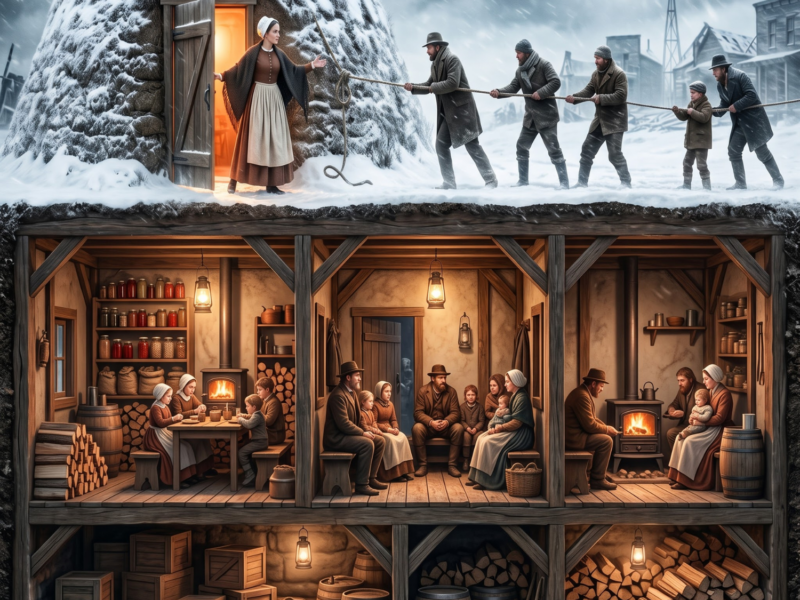
They Mocked Her Sod House—Then a Historic Blizzard Trapped the Entire Town ❄️
The Silent War
Mayor Cecil Pratt raised the subject at a town gathering that fall. He spoke in the measured, reasonable tone of a politician who believes he is offering gentle, patriarchal guidance to a wayward sheep.
“A woman expecting to live in harmony among her neighbors,” the Mayor pronounced, adjusting his lapels, “should build a home to welcome them, not a fortification to repel them.”
Several prominent citizens nodded their enthusiastic agreement.
Margaret Briggs, Harlon’s wife, was a woman who possessed a terrifying gift for social exclusion administered entirely through aggressive politeness. She continued hosting regular Sunday gatherings, quilting circles, and teas that reached almost every single woman in Cedar Flats.
Ruth Kalen’s name was never once on an invitation.
These glaring omissions were never verbally explained or justified, which made them infinitely more effective than any direct confrontation ever would have been. It was a weaponization of silence.
Norah felt the sharp edges of this silent war at school. She felt it in the way certain birthday invitations simply never arrived for her. She felt it in the way clusters of girls would abruptly stop their excited whispering the moment she drew close to the pump. She was only nine years old, but she was paying attention to the world.
She carried the ostracization home, but she never brought it to Ruth as a complaint. And Ruth, respecting her daughter’s silence, never asked.
They both understood, in the profound way that isolated families understand things that are never spoken aloud, that what was happening down in the town was a kind of atmospheric pressure. It was continuous, low-level, and specifically designed to produce a particular result—submission, failure, and departure.
The result it was actually producing on the hill was not the one Cedar Flats intended. It was forging them into iron.
One evening in late October, a neighboring farmer passing on the road below slowed his horse and called up toward the work site. His voice carried the loud, cheerful edge of a man who has just thought of something incredibly clever and wants an audience.
“Still building that monument to stubbornness, Mrs. Kalen?” he shouted.
He did not wait for an answer. The road curved, his horse moved into a trot, and he was gone in a cloud of dust.
Norah, who was kneeling in the dirt bundling grass nearby, watched the empty road for a long moment after he disappeared. Her small jaw tightened. Then, she picked up the next bundle of grass and kept working, moving faster than before.
Ruth had not looked up from her trowel at all.
The pattern of each day had established its own relentless rhythm by now. Cut, haul, stack, pack, mix, repeat.
And within that rhythm, certain vital things happened completely without being directed. Tom instinctively found the exact spots where old Bessie’s leather harness chafed her hide, and he adjusted the heavy traces before the mule was ever asked to pull a load. Norah learned to keep the grass bundles sorted in a particular, meticulous order that made it easy for Ruth to grab the exact right size without ever having to stop and search.
And Ruth kept the notebook.
Every single evening, without ceremony, by the light of a single candle, she recorded exactly what the day had shown her. Temperature. Wind direction. Fuel consumed. Meticulous observations about the structure’s behavior in different humidity conditions.
The entries were incredibly brief. But they accumulated like the wall itself—one layer at a time. And each layer carried the immense weight of everything below it.









