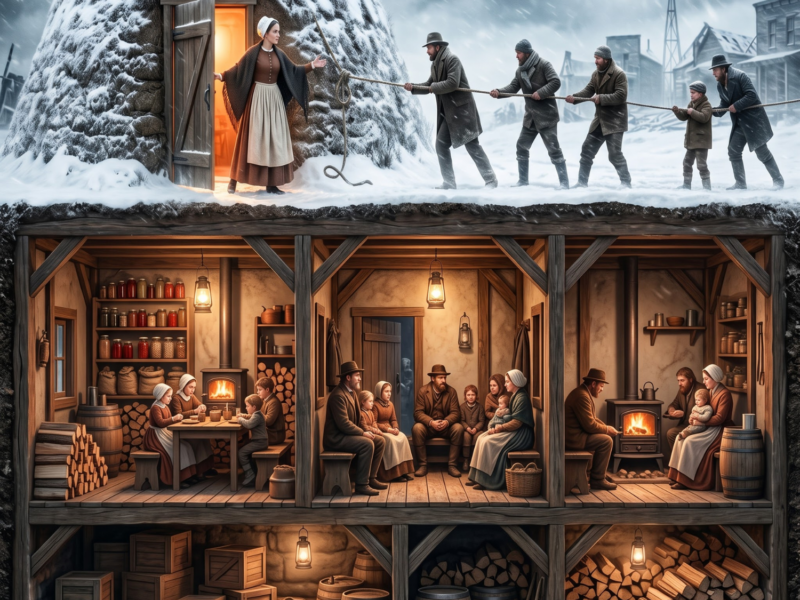
They Mocked Her Sod House—Then a Historic Blizzard Trapped the Entire Town ❄️
The Collapse
The first genuine crisis arrived the following spring, in the form of rain.
It was not a violent, driving thunderstorm. It was three days of rain coming in from the east. It was a steady, patient, soaking rain. It was not dramatic, but it was relentless. The prairie drank until it could hold no more, and then it turned to soup.
The unfinished east section of the wall had not yet received its interior bracing framework. On the fourth morning, as the gray light broke, Ruth walked out to find a narrow, ominous crack running diagonally near the base of that massive wall.
By mid-afternoon, the entire section had visibly shifted outward.
Then, with a sickening, wet slump, a large portion of it simply gave way. It did not collapse catastrophically, bringing down the roof, but it crumbled enough to leave a glaring, gaping gap in the structure that could not be hidden or explained away.
By evening, the town of Cedar Flats knew.
Harlon Briggs heard the news before he had even sat down for supper. His laughter echoed out into the street—the loudest, most triumphant it had been since he coined the name.
“The grave is sinking before they even have a chance to bury themselves in it!” Harlon roared to his patrons.
Men who had watched the project from afar with private, gnawing uncertainty suddenly found in this collapse the absolute confirmation they had been desperately looking for. It validated their own choices to build flimsy wooden boxes. Several men rode their horses out the very next morning specifically to see the damage. They sat in their saddles at the base of the hill and looked up at the collapsed section of sod with the deeply satisfied expressions of people whose skepticism has just been gloriously rewarded.
Up on the hill, Ruth ignored them entirely.
She spent an hour standing at the damaged wall in the drizzle. She moved around it slowly. She studied it from different angles. She dug her bare hands into the mud, running her fingers along the jagged fracture line, feeling the density of the earth.
She identified the failure with the exact same clinical detachment she brought to her daily weather observations.
The wall had possessed massive weight and basic structural integrity, yes. But it lacked internal distribution. She had built no framework to spread the enormous load and the hydrostatic moisture pressure evenly across the section. When the relentless water had finally shifted the density of the soil at the base, the heavy wall above it had absolutely nothing to redistribute the resulting stress. It failed at the weakest point.
She did not curse God. She did not blame the rain. She did not abandon the design concept. She blamed a specific, correctable mechanical omission.
The following morning, she began dismantling the massive, failed section by hand. Block by heavy, muddy block. Layer by layer. She took it down in the exact reverse order she had placed them.
The men watching from the road expected to see a woman weeping in the mud, throwing her hands up in defeat. They watched instead as a woman systematically took apart weeks of backbreaking labor with the exact same quiet, terrifying efficiency she had brought to laying it.
When the damaged section was fully removed and the base cleared, she began to rebuild. But she rebuilt it differently.
She sent Tom to the creek to cut hundreds of flexible willow branches. She cut them into specific lengths and wove them intricately through the interior of the new wall courses at regular intervals. She was creating a hidden, flexible skeleton inside the earth that would distribute downward pressure laterally across the full width of the section. The clay was packed tighter this time. The layers were bonded differently, interlocking the willow matrix.
The repair took thirty-one agonizing days of labor.
When it was finally finished, the east wall stood straighter, firmer, and vastly stronger than any other section on the site.
The laughter down in Cedar Flats did not stop entirely, but it shifted slightly in tone. It shifted the way laughter always does when the thing being mocked stubbornly refuses to do what you so confidently predicted it would do.









