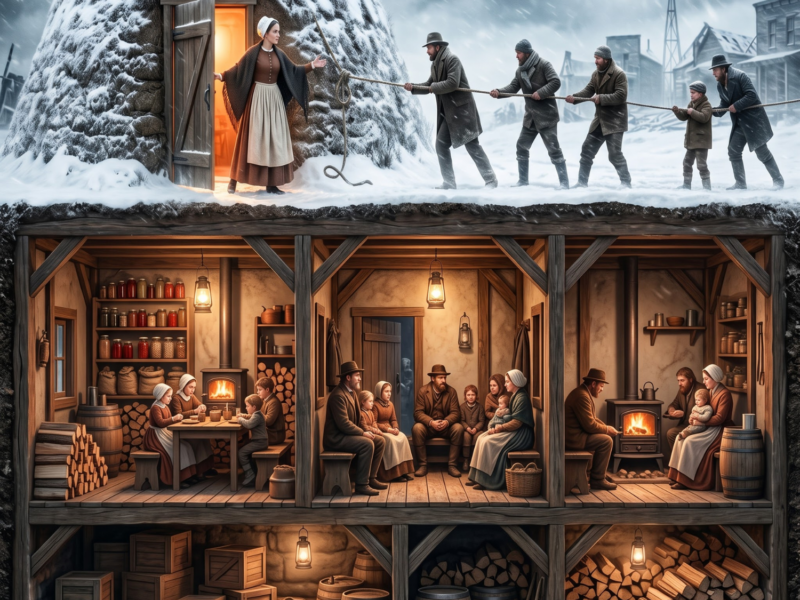
They Mocked Her Sod House—Then a Historic Blizzard Trapped the Entire Town ❄️
The Approach of the Blue Wall
The entries for the first two weeks of January 1884 were utterly unremarkable by the harsh standards of a Nebraska winter. It was cold, and consistent. The cast-iron stoves were doing their work, the fuel supply was tracking perfectly at the projected rate. Ruth noted absolutely nothing unusual in the ledger. She watched the northwestern horizon each morning out of ingrained habit, more than actual expectation. It showed her nothing but gray.
Cedar Flats went about its winter in the way small, isolated towns go about hard winters—with a combination of stubborn endurance and loud complaint that is essentially the exact same thing as endurance, just noisier.
On the morning of January 17th, the temperature dropped to the absolute lowest point Ruth had recorded in four continuous years of measuring.
She noted it in the ledger without alarm, added extra fuel to both massive stoves, and spent the freezing morning physically checking the tension on the safety rope guides she had strung around the perimeter of the hill.
On January 18th, the temperature rose.
It was not a dramatic, sudden thaw. It was not the kind of rise that joyously announces itself. But it was highly measurable. And in the stark context of the previous day’s extreme, record-breaking low, the rise had a sinister character that the number on the thermometer alone did not convey.
Ruth felt the wrongness of it before she even measured it.
She stepped outside in the early morning of the 18th and stood for a while with her face turned toward the northwest. The sky was perfectly clear. The prairie was dead still. Everything looked exactly as it should look on a normal, cold January morning in Nebraska.
She went inside, sat at the table, and opened the notebook to a specific entry from three winters earlier. The one with her tiny marginal notation. She read the weather pattern she had documented then. She looked at the outdoor temperature she had just recorded today. She looked at the date. She looked out the window at the deceptive calm.
She did not sleep well on the night of January 18th.
It was not from fear. Panic was not an emotional mode she operated in—not because she was biologically incapable of it, but because she had found over many hard years that fear produced useful action vastly less efficiently than cold observation did.
She lay awake because she was still actively reading the invisible evidence. She was turning it over in her mind, checking it against what she knew to be true, trying to determine whether what she suspected was the lethal pattern she had identified years ago, or merely a pattern she was projecting because she was looking for it. They are two different things, and they carry two very different weights when lives are on the line.
By the time the sky began to lighten into a pale dawn, she had arrived at a mental position. It was not absolute certainty. Certainty was not available to her. But it was a clear-eyed assessment of probability that was severe enough to act upon.
She rose from her bed before Tom or Norah were even awake. She went straight to the notebook.
She wrote: January 19th. Temperature elevated unnaturally from yesterday’s extreme low. Northwest Horizon—watch before 9:00 a.m. If pattern holds: fill all barrels. Stoke both stoves to full. Check all exterior rope. Bring cellar stores up to main room.
She closed the notebook with a snap. She dressed in her heaviest clothes. She went outside.
The morning air was notably, disturbingly warm. Not warm by any standard that would apply in April, but warm in the specific, anomalous way that something is warm when its warmth is a lie. The kind of warmth that has absolutely no business being where it is.
She stood in the strange, balmy air for a while, facing northwest. Then she walked to the very edge of the rise and looked at the distant horizon in the early light.
The line was there.
It was incredibly thin, resting very low on the earth. The deep, bruised blue-gray of something massive that had not yet fully committed to being visible.
Most people in Cedar Flats would have walked out of their doors, looked at the exact same horizon that morning, and seen a beautifully clear sky with a slight, hazy optical illusion at the edge.
Ruth Kalen looked at it and saw exactly what Walt Prior’s massive hand, pressing against a sod wall in a blizzard twenty-two years ago, had been telling her to watch for.
She stood on the rise and stared at that blue line until she was absolutely certain she was seeing it clearly, and not inventing it out of paranoia.
Then she turned and went inside.
Tom was in the yard chopping kindling when she came back through. Her voice did not carry an ounce of alarm. Alarm was noise, and noise interfered with the crucial information being transmitted.
“Check the tension on every rope on the hill right now,” Ruth commanded.
Tom stopped chopping. He read her face the way a person reads a face they have been studying for sixteen years. He dropped the axe and moved toward the perimeter without a moment’s hesitation.
Norah appeared at the bedroom doorway, still pulling her long hair back into a braid.
“Ruth,” she said.
“All spare blankets out,” Ruth fired back. “Lamp oil from the back shelf. Move.”
Norah was already turning toward the storage room before the sentence was finished.
Both cast-iron stoves went to a full, roaring draw. Every water barrel in the house was filled to the brim from the interior tank Ruth kept from freezing through the winter. Food was hauled rapidly up the ladder from the root cellar. She did not bring up everything—it was a calculated, mathematical selection of high-calorie items that would feed the absolute most people, most efficiently, in a confined period.
Ruth executed this herself, moving quickly down the cellar stairs, filling heavy baskets with the efficient, ruthless selectivity of someone who had organized this inventory specifically to be accessed under extreme pressure.
The morning continued to warm. And the blue line on the horizon continued to grow.
By mid-morning, it was no longer possible to call it thin. It had spread across the entire northwestern quarter of the sky with the unhurried, terrifying confidence of something that had already made its decision to destroy whatever lay in its path.
Ruth stood at the small window and watched it. She watched it the way a ship’s navigator watches a jagged reef approaching in a gale—not with screaming fear, but with the intensely focused attention of someone tracking a fixed point of impact while preparing to brace for the collision.
Cedar Flats, lying exposed in the valley below the hill, continued its morning without a shred of visible concern. Wagons moved lazily along the muddy roads. Smoke rose from chimneys in the ordinary, lazy pattern of a mild winter day. The freakishly warm air was being gladly accepted as a divine gift, rather than read as a terminal warning.
Agnes Moore had her eighteen students inside the schoolhouse by eight o’clock in the morning. The potbelly wood stove was already burning brightly against the morning chill.
Agnes was twenty-six years old. She had come to Cedar Flats from a small town in Indiana three years earlier, armed with a teaching certificate, a highly practical disposition, and absolutely no experience with the specific, lethal dynamics of a Great Plains winter. She was not an unintelligent woman. She was not careless with her students. She simply had not yet accumulated the precise, bloody kind of knowledge that comes only from sustained, recorded observation of a particular landscape under extreme stress.
She knew the schoolhouse was drafty in winter. She knew the stove worked hard to hold the room temperature. She knew that bad weather in January was a normal feature of life.
At ten o’clock in the morning, Agnes opened the schoolhouse door to let a young student out to use the pump. She felt the strangely warm air wash over her face. She stood in the doorway for a moment, looking up at the sky. It was pleasant. The sky directly above the town was a brilliant, clear blue. She smiled, closed the door, and went back to teaching fractions.
Up on the hill, Ruth was moving rapidly through the fortress with the deliberate economy of someone running a life-or-death checklist they have rehearsed in their mind until it requires zero conscious thought.
The inner vestibule door was checked for seal. The exterior rope guides were visually confirmed tight.
The massive east-wing storage area was thrown open and its floor rapidly cleared. Blankets and spare fuel were stacked against the walls in a specific arrangement that would make the vast space instantly usable for frightened people, rather than for goods. Bessie the mule was secured in the shelter, her hay trough topped up to the brim.
Ruth came back to the main room. She looked at the two stoves burning at full roar. She looked at the full water barrels. She looked at the heavily stocked shelves.
She picked up her heavy winter coat.
She had not discussed with Tom or Norah what might happen next. She had only told them what to do if more people arrived. She had told Tom exactly which exterior ropes led where in the blinding snow. She had told Norah exactly where the extra tin cups were kept. They were young, but they were not unprepared.
And on the hill, in late January of 1884, prepared was the only category of human existence that was going to matter.
By noon, the blue line was a towering, bruised blue wall, swallowing the sky.
Ruth stood at the crest of the rise and watched it come across the prairie. She watched with the particular patience of someone who is not surprised by the monster they are seeing, but is nonetheless measuring its teeth—reading its speed, reading its terrible density, reading the precise, mathematical moment when preparation must become action.
The wind had already begun to shift. It wasn’t the full, violent shift yet, but the preliminary, shivering movement. It was the atmosphere’s formal announcement of execution.
Down below in Cedar Flats, a few people had finally started looking at the sky. Their expressions had lost their earlier, sunny confidence. A few men had started moving quickly toward their homes. The warm morning had tipped over into something deeply wrong, and that wrongness had the heavy, terrifying weight of a door about to be violently kicked open from the other side.
Ruth turned her back on the wall of blue and walked briskly toward the house. She did not run. Running was for situations where you had failed to prepare in advance and were desperately hoping speed could substitute for foresight. She had spent four grueling years preparing for this exact hour. She had checked every rope. The stoves were burning. The barrels were full.
She walked inside, picked up a massive coil of heavy hemp rope from beside the door, and looped it diagonally over her shoulder. She checked the shorter rawhide lines clipped to her heavy leather belt.
She looked at Tom.
“Stay here,” she ordered. “Keep both stoves roaring. If the door shakes, let it shake. Do not open it for any reason unless it is me, or you know the voice absolutely.”
Tom held her gaze. He was sixteen years old, standing in the massive, silent room his mother had spent four years building. Standing in a structure that had been mockingly called a grave by most of the people he had grown up around. His face showed none of the lingering doubt that cruel name had once put there. He nodded firmly.
Ruth pulled on her heavy coat, buttoning it to her chin. She looked at Norah, who was standing perfectly still near the east-wing doorway, clutching a massive stack of wool blankets against her chest.
Norah’s expression was incredibly serious. It was the face of someone who has been told the exact, terrifying shape of what is coming, and has actively decided to meet it prepared rather than paralyzed by fear.
“Norah,” Ruth said softly.
“I know what to do,” Norah replied. There was no childish defiance in her voice. There was only a terrifying certainty, as quiet and straight as the smoke columns from the test lamps the month before.
Ruth looked at her daughter for one long moment. Then, she opened the heavy oak door.
The blue wall was incredibly close now. The warm morning was entirely gone. The wind had shifted violently to the north.
Ruth had spent four years bleeding to build the thing that was standing safely behind her. Now, she was walking straight toward the horror it had been built to defeat.









