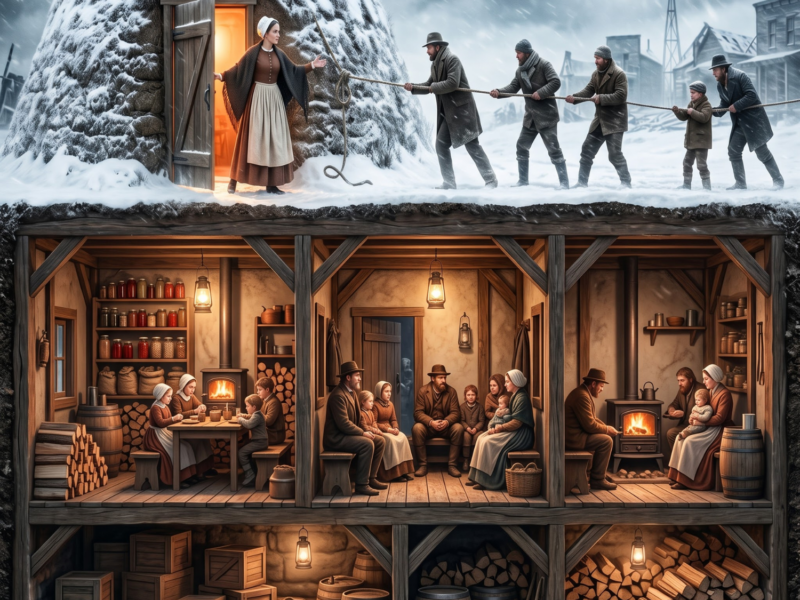
They Mocked Her Sod House—Then a Historic Blizzard Trapped the Entire Town ❄️
The Meeting in the Earth
Three days after the storm, with the roads finally cleared enough for wagons and sleds to move, Cedar Flats gathered inside the structure on the rise.
There was absolutely no other building left standing large enough to hold them all. There was no other building structurally sound enough to be trusted with the weight of that many people in January.
They came up the hill in the biting cold, filing through the outer door into the warm, still air inside. They settled into the main room and the east wing with the particular, reverent quietness of people who are aware they are in a place that has earned something profound from them.
For a long while, nobody spoke.
Agnes Moore stood up. She looked at the heavy hemp rope still hanging on its hook beside the door—the line that had connected eighteen children across a half-mile of white blindness two days before.
“Hope is not enough,” Agnes said, her voice clear.
Her eyes moved to the thick sod walls, then to the massive ceiling timbers, then back to the room full of people who had just spent two days in a building that had completely refused to participate in the disaster happening around it.
“The walls were enough.”
Several people lowered their heads. Several others nodded without looking up. The storm had already made the argument. Agnes was only reading aloud the verdict it had written.
Ezra Holt said nothing. From his position leaning near the back of the room, he looked at Ruth with the steady, calibrated gaze of a man who had spent four years measuring a thing against his own best, most educated predictions, and was now standing in the room where every single one of those predictions had been definitively settled. He did not speak. He did not need to. The look was the statement.
Mayor Pratt spoke next, because mayors speak in these moments whether or not they have something new to add. He spoke about rebuilding, about hard lessons, about the resilient future of Cedar Flats, and the critical importance of what had been demonstrated on this hill. He spoke competently. People listened without particular engagement. What had happened on the prairie two nights ago did not require political framing. It had framed itself.
Ruth sat for a moment after the room turned its collective attention to her. She was deeply uncomfortable at the center of a gathering, and showed it in the way of people who have spent most of their lives working rather than being observed.
She looked at Tom, who was standing near the stove with the careful stillness of someone trying not to be noticed. She looked at Norah, who was standing near the east-wing doorway with her hands clasped in front of her. Norah’s expression was the expression of a thirteen-year-old girl who has spent four years carrying heavy grass bundles, sorting blankets, and recording temperatures, and who has just learned in the most definitive, terrifying way available that those things mattered.
Ruth stood up. She put her hand flat on the nearest earthen wall. Not for theatrical effect, not as a gesture, but because the wall was there and it was solid.
“This wasn’t built by one person,” Ruth said. She let the room settle around that truth. “Tom carried water until his shoulders gave out.”
Tom’s face did something he could not entirely control, a flush of pride creeping up his neck.
“Norah gathered grass when other children were playing,” Ruth continued.
Norah looked at the floor briefly, then back up, her chin steady and proud.
“Ezra Holt asked the hard questions,” Ruth said, looking at the old builder. “And the hard questions made it stronger.”
She stopped. The room was very quiet. The two stoves made their small, comforting sounds. Outside, the January wind moved across the prairie in its ordinary way, testing surfaces, searching for weakness, doing exactly what it had always done.
“Build for the worst day,” Ruth said.
The words settled into the room without drama, without the pompous weight of someone who believes they are delivering a profound maxim. They settled the way the sod walls had settled—one heavy layer at a time, each carrying the weight of everything below it.
“Not the average one.”
Epilogue: The New Architecture
In the two years that followed the great storm, visitors passing through Cedar Flats noticed things that had not been there before.
The new houses being raised had walls significantly thicker than the previous territorial standard. Root cellars reached much deeper into the ground. Front entrances gained secondary wind barriers—not elaborate architectural features, just a simple second door, set eighteen inches behind the first, creating a small, enclosed airlock that kept the transition between the brutal outside and the warm inside from being instantaneous.
Heavy guide ropes ran semi-permanently from houses to outbuildings. Ventilation gaps appeared deliberately at roof lines. Storage quantities in pantries and cellars increased, calculated not against an “average” winter, but against the kind of winter that arrives without courtesy and intends to kill.
Nobody called these features unusual. Nobody called them excessive. People called them sensible.
Some builders gave the thick wall construction a name: the Kalen Wall. Partly because it was accurate, and partly because Cedar Flats had desperately needed to put something respectful in the place where Kalen’s Grave had been, now that the storm had retired that cruel name permanently. It wasn’t done officially, through any declaration or ceremony. The old name simply stopped being used. The way jokes instantly stop being funny when the thing they mock has proven itself entirely beyond the reach of mockery.
Tom grew into a quiet man who built things with incredibly thick walls and deep foundations. When asked by newer settlers why he built the way he built, he did not always find it easy to explain in words what he had learned through years of agonizing physical repetition. He built the way he had been taught—by watching rather than being instructed, which is the vastly deeper kind of teaching.
Norah kept her own notebook. She had started it the winter after the storm, using a blank leather ledger she bought at the sturdy new building that had been rebuilt to replace Harlon Briggs’s store. Her entries used the exact same format as her mother’s: Date. Temperature. Wind direction. Fuel consumed. Observations. Because the format was not an arbitrary choice, but the necessary record of what actually needed to be watched to survive.
Ezra Holt lived four more years. He spent them building exclusively with sod where previously he would have used imported stone or timber. He adapted his technique from what he had critically examined, measured, and ultimately acknowledged in the structure on the hill. He never described this to anyone as a change of position. He described it as a necessary revision of method based on new, undeniable evidence. For Ezra, there was no meaningful distinction between those two things.
Harlon Briggs rebuilt his massive general store with walls eighteen inches thick, on a stone foundation that reached well below the frost line. He hired Ezra to consult on the construction. He did not make a public statement or an apology about the decision. He made a building. The building said exactly what he intended it to say.
The heavy hemp rope stayed on the iron hook beside the outer door of the fortress on the rise.
Ruth did not move it. She did not coil it up and put it away in a trunk, as though the emergency was over and the rope was now surplus history. She kept it exactly where it was, at the same height, on the same hook, because the prairie was the exact same prairie. The January sky was the exact same sky. The northwestern horizon would show the exact same bruised blue line when the conditions were right again.
The notebook stayed on the same shelf. The stoves were meticulously maintained on the exact same schedule. The root cellar was restocked each autumn to the exact same depth.
On the hill, in the structure that Cedar Flats had once mockingly called a grave, and now called, without a trace of irony, the most reliable building in the county, Ruth Kalen sat at the same rough wooden table on winter evenings.
She opened the exact same notebook she had kept since the year she laid the very first sod course. The entries were the same length they had always been: short, factual, dated, precise.
Temperature. Wind. Fuel. Observations.
She wrote what the day had shown her. She closed the book. She banked the fire.
She went to bed in a building that the lethal cold could press against all night long without ever getting inside. Because the cold was not the problem. The cold had never been the problem.
The moving air was the problem.
She had built something that stopped the moving air. Everything else had simply followed from that.









