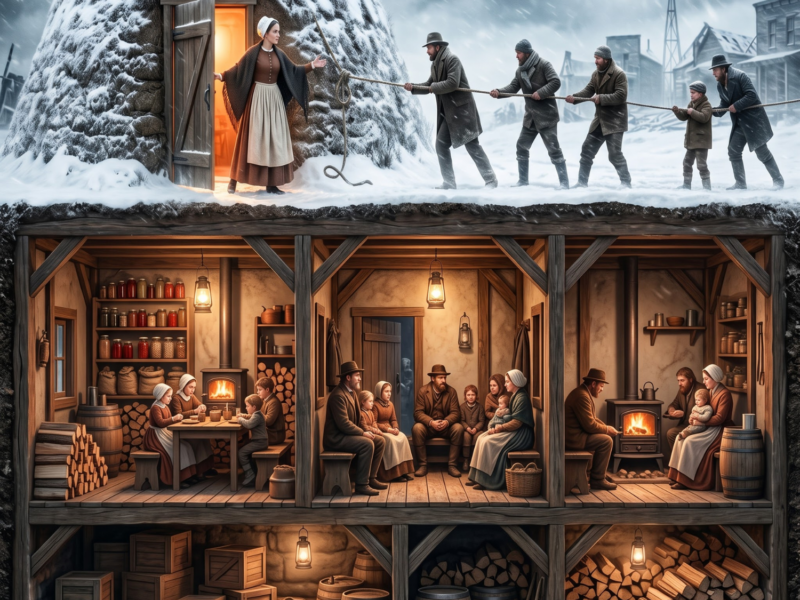
They Mocked Her Sod House—Then a Historic Blizzard Trapped the Entire Town ❄️
The Harrowing of Cedar Flats
The first trip back down the hill found Ida Crane.
Ida had her two remaining daughters pressed desperately against the interior wall of her small, wood-frame house. The building was actively losing the argument with the storm. It was failing through a fatal combination of thin pine boards, inadequate chinking, a chimney drawing poorly in the violent wind reversal, and a shallow foundation that had allowed the north end of the building to shift when the ground froze hard.
The stove was lit, but its radiant heat was leaving the room exponentially faster than it could be replaced. Ruth could feel the thermal failure as a sensory fact within two seconds of kicking through the door—the terrifying cold was actively radiating from the walls, rather than just from outside them.
She looked at Ida. Ida looked back at her with the wide, blank expression of a terrified woman who has been waiting for a decision to arrive from somewhere outside her own exhausted reasoning.
“We can get there,” Ruth shouted over the wind. It was not a question.
Ida stood up immediately. She lifted her youngest daughter, took the heavy rope Ruth offered with her free hand, and did not ask where it led. The older daughter took the middle section without being told. They went out together into the white.
The second trip reached Ezra Holt.
A massive section of the blacksmith shop’s roof had peeled back in a single, catastrophic piece under a wind gust that must have found a leverage point in the overhang. It was a structural vulnerability that Ezra, working alone in his old age, had never fully reinforced because it was above the height he could safely manage without a second person.
The gaping opening admitted a blinding column of wind-driven snow that had already built a waist-high drift across half the interior dirt floor.
Ezra was standing near his massive iron anvil in the particular posture of a man who has assessed his situation with perfect accuracy, and is not certain what to do with the grim assessment. He was wearing two heavy coats, and a thick canvas apron over both of them. And he was still freezing to death in a way that the coats were not addressing, because the killing cold was coming in from above rather than through the walls.
He looked at Ruth. He looked up at the gaping hole in his roof. He looked down at the lifeline rope in her hand.
His voice was dry as old timber over the roar of the wind. “I have been wrong about several things this week, Ruth.”
He took the rope.
The third trip pressed deeper into the residential quarter, where a young family named Marsh—husband, wife, an infant, and two children between—had frantically barricaded their front door against the wind using their heavy kitchen table. It told Ruth absolutely everything she needed to know about the failing state of the doorframe.
The infant was too young to register the freezing cold as anything other than a profound wrong that required immediate correction, which it expressed continuously with thin, reedy screaming.
Ruth got them all connected to the line in under three minutes. The infant quieted miraculously when Ruth pressed it tightly against her own chest, inside her coat, during the transfer. She handed the baby back to its weeping mother once they were clipped securely to the main rope, acting with the practical gentleness of someone who has managed fragile things in impossible conditions before.
The fourth trip took much longer.
The wind had found a new orientation, rotating slightly west of north. This shifted the pressure dynamics against the structures on the lee side of Main Street. Buildings that had been marginally adequate an hour earlier were now taking the brunt of the storm from a different, deadly angle, revealing structural weaknesses their original orientation had concealed.
A massive section of the hardware store’s east wall had buckled inward. It had not collapsed yet, but it was violently deformed—a visible, groaning bow in the planking that spoke to the terrifying tons of force being applied from the outside.
Ruth collected the terrified hardware merchant and his elderly mother from the adjoining residence and added them to the rope. The old woman moved with a slowness that was not stubborn resistance, but the irreducible minimum speed of a fragile body in its eighties being asked to move through a blizzard.
The fifth trip went to Harlon Briggs.
She found his massive general store entirely dark. The lamp oil in the front room had been allowed to run down, which meant either the lamp had not been tended, or someone had retreated away from it.
She forced her way through the rear entrance, which was partially sheltered by the building’s massive bulk on the windward side. She found the Briggs family huddled in the back storage room. Margaret was on the floor, weeping, with both children clutched in her lap. A single, guttering candle burned on a crate nearby.
The wooden walls of the storage room were showing the particular, terrifying vibration of boards that have been moving continuously under immense load for hours, and are actively developing opinions about how much longer they intend to continue holding together.
Harlon was standing, facing the outer wall, one hand pressed perfectly flat against the groaning planking.
He was feeling exactly what Ruth had felt in poorly built buildings all afternoon: the terrifying difference between a wall that holds, and a wall that is deciding to fail.
He heard her come in. He turned.
Harlon Briggs was not a man whose face showed much emotion ordinarily. It was the cultivated impassivity of someone accustomed to ruthless commercial negotiation. What his face showed now was not fear, exactly. It was the specific, deeply private expression of a proud person who has been carrying a position they no longer believe, and whose body, under sufficient pressure, has simply stopped helping them maintain the arrogant performance.
He looked at Ruth covered in snow. He looked at the heavy rope in her hands. He looked at his sobbing wife on the floor with their freezing children.
The wall behind him made a horrific sound—wood under massive load communicating in the only language available to it: a sharp, cracking snap.
Ruth held out a section of the rope. “Stay close to me.”
It was not a command. It was a condition of survival, stated plainly, without an ounce of history or gloating attached to it.
Harlon took the rope. His hands, she noticed, were completely steady. Whatever else was true about Harlon Briggs’s vanity, he was not a man who fell apart when the situation finally clarified itself into life or death.
He helped Margaret up from the floor, took the younger child in his arms, tucked the rope under his armpit, and looked at Ruth one more time with an expression that contained vastly more information than either of them had time to process.
Then he turned toward the door. They went out into the storm together, connected by a lifeline Ruth had spent years preparing to use.









