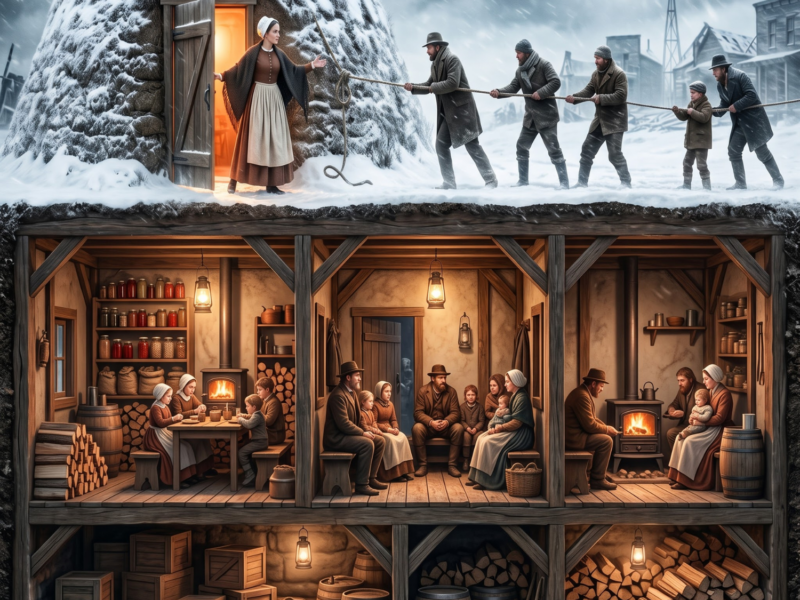
They Mocked Her Sod House—Then a Historic Blizzard Trapped the Entire Town ❄️
The Architecture of Grief
Jacob Kalen died in the muddy spring of 1877 from a wet lung sickness that the young doctor in the nearest town could neither name nor successfully treat.
Jacob had been a deliberate man. He was steady, careful, and possessed a quiet strength. He was the kind of husband who made decisions agonizingly slowly, but kept them forever once they were made. When he finally succumbed to the fever, he left behind a homestead claim that was technically solvent, two children who had learned not to cry in front of strangers, and a wife who had already been building something in her mind for years.
His death did not break Ruth. It gave her the specific, clarifying grief that instantly turns theoretical thought into concrete action. Ruth did not rebuild their life after losing Jacob. She redirected it. The grief did not make her fragile; it made her terrifyingly precise.
By 1879, the great wave of westward settlement rolling through the Nebraska territory had reached the flat, grassy land surrounding Cedar Flats. Families arrived by covered wagon, excitedly staked their claims, and immediately began raising houses on ground that was easy to reach and easy to plow.
They built on the fertile creek bottoms and the vast, flat stretches where the prairie lay as smooth as a dining table. They built with expensive, milled wood hauled by rail and wagon from forests far away. They built in the exact architectural styles of the houses they had left behind in the sheltered valleys of Ohio, Indiana, or Missouri—tall, balloon-frame structures with steep roofs, large glass windows, and open layouts designed specifically to capture breezes during mild, humid summers.
They built exactly where the ground was convenient. Which was also, Ruth noted silently as she watched them, exactly where the water went when it wanted somewhere to go.
Ruth studied the virgin land around Cedar Flats the precise way Walt Prior had studied the weather—not for what it showed on a sunny afternoon, but for what it remembered.
She saw that the shallow drainage cut curving through the low ground southwest of town recorded the violence of every spring flash flood in the eroded depth of its banks. She saw that the tall grass and the low, protected hollows remembered exactly where the deepest winter snowdrifts settled. She saw that the exposed, northern faces of every gentle rise were scoured entirely clean of topsoil, a geographical fact that told the entire, violent history of the wind without a single spoken word.
Ruth read all of it before she drove a single wooden stake into the earth.
The piece of land she finally chose was the one absolutely nobody else had even considered. It was a low, stubborn rise northwest of town, standing as the highest ground for a mile in any direction.
The climb up the rise was highly inconvenient. Heavy wagons labored and slipped on the approach. Every drop of water would have to be hauled uphill by hand. The physical distance from neighbors was significantly greater than the standard plotted claims.
Three separate men from town—including the Mayor—approached her. They spoke to her in the kind, patronizing tone men use when they genuinely believe they are preventing a hysterical widow from making a catastrophic error. They told her the location made absolutely no practical sense for a farm.
Ruth listened to each of them fully, her face impassive. Then, she walked back up the hill and drove her survey stakes deep into the frozen soil at the crest.
She did not bother to explain herself at length. Explanations, she had found, rarely changed the minds of people who had already decided what they thought was true.
But once, when a particularly persistent neighboring farmer pressed her aggressively on the logic of her foolish choice, she turned toward the drainage cut below and pointed a gloved finger.
“Water knows exactly where to go in this country,” she said flatly.
Then she turned toward the vast, open northwestern expanse of prairie, where the winter wind crossed without a single tree or interruption for fifty miles before it slammed into the town.
“So does the wind.”
She let both facts sit in the air without further elaboration. The farmer stared at her, shook his head in disgust, and rode away. Ruth picked up her heavy iron shovel.









