They Mocked Her Sod House—Then a Historic Blizzard Trapped the Entire Town ❄️
The First Winter
The first winter inside the finished structure was the long, grueling winter of 1882 to 1883.
Ruth lit both cast-iron stoves on the first genuinely freezing night. Once the room reached a comfortable temperature, she systematically adjusted the dampers downward, choking off the airflow until the fires were barely more than glowing coals.
The staggeringly thick earthen walls absorbed the heat incredibly slowly. But they also released it incredibly slowly. This meant the interior temperature was vastly more stable than a drafty wood-frame house, and crucially, required a fraction of the fuel to maintain once the massive thermal mass of the walls was fully “charged” with warmth.
She had expected this outcome from the physics. She had not been certain of the sheer degree of the efficiency until she began measuring it.
Each morning, before dawn, she recorded the outdoor temperature, the indoor temperature, and the exact quantity of wood burned in the previous twenty-four hours.
The outdoor temperature swung wildly, from freezing rain to sub-zero blizzards. The indoor temperature did not.
By late December, her fuel consumption was running at roughly half of what she had originally estimated for a structure of this immense size, based on what her gossiping neighbors typically reported burning. She checked her mathematical figures. She checked them again. The numbers stayed exactly the same.
Down in the valley, Cedar Flats was burning wooden fence rails by February.
Woodpiles shrank exponentially faster than people had planned for, because the winter was longer and far more vicious than usual, and their thin wooden houses were bleeding heat faster than usual.
The two facts combined in the way that unpleasant facts always combine on the frontier: into a specific, life-threatening material problem that required a desperate material solution.
People burned extra dining chairs. They burned broken wagon boards. Desperate men rode out into blinding snow to cut whatever standing timber was close enough to haul back before dark, risking their lives for a night’s warmth. The mathematics of survival narrowed to a terrifying point.
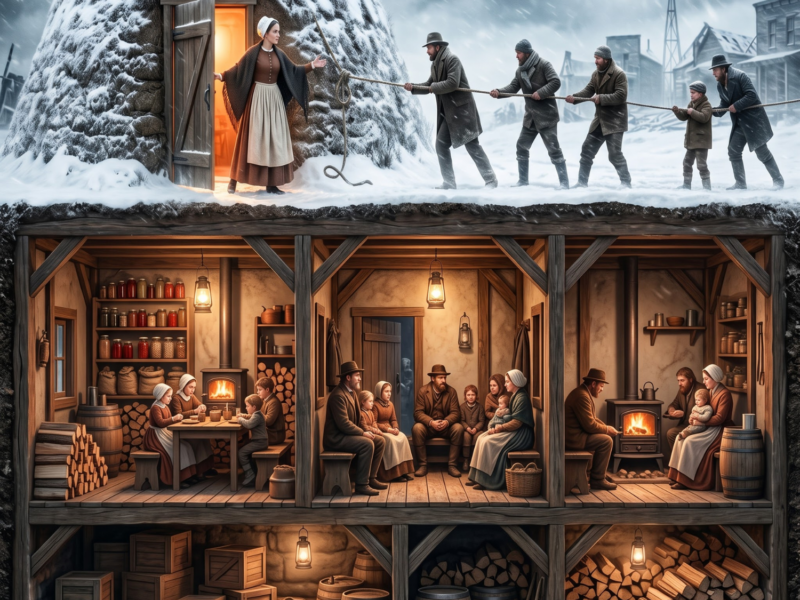
Up on the hill, the fires inside the grass fortress—Kalen’s Grave, as Cedar Flats still stubbornly called it—burned small, low, and perfectly steady.
Ruth did not tell anyone in town about her numbers. She simply recorded them. She noted the thermal patterns. She maintained the notebook with the exact same relentless regularity she maintained the stoves.
When Ezra Holt came to visit in early January during a particularly sharp, bitter cold spell, Ruth simply handed him the open notebook without a single word of comment, and let him read.
He sat at the rough wooden table and went through every single page. He checked the temperatures. He examined the meticulous fuel records. He compared her figures to what he personally knew of the brutal winter’s conditions across the region. He spent a very long time staring at the December and January entries. He turned back to re-read the November baseline data.
He closed the heavy ledger. He looked at the earthen wall across from him for some time in silence.
Ezra’s voice, when it finally came, carried the particular, heavy weight of words chosen extremely carefully by a man who does not speak carelessly.
“These numbers are correct.”
It was not a question. He already knew the undeniable answer. He was saying the sentence out loud because saying it out loud was the physical act of accepting what it meant for everything he thought he knew about building.
Ruth nodded. Confirmed.
He rose slowly from the table and walked to the nearest wall. He did not knock on it with his knuckles this time. He simply laid his large, calloused palm perfectly flat against the interior surface of the mud plaster, and he held it there.
He touched it the way a person checks whether a cast-iron stove is still warm after the fire has been banked for the night.
The wall was not hot. It was not cold. It was something vastly more useful than either: it was stable. It was maintaining a perfect, ambient temperature that the surrounding air could settle against without expending any effort.
Ezra stood like that, his hand on the wall, for far longer than was required by any practical assessment.
When he finally turned back toward the room, the expression on his weathered face was one Ruth had absolutely never seen from him before. It was not the careful, guarded neutrality of a master craftsman withholding judgment. It was the specific, deeply private expression of a man completely revising a calculation he had been proudly confident about for a very long time.
He left without saying much. But on the porch, with one hand resting on the heavy doorframe, he stopped and looked back at her.
“Come spring,” Ezra said, his breath pluming, “I want to look inside the walls.”
It was not a request, exactly. It was a declaration of intention from a man who knew he had been wrong about something fundamental, and intended to establish precisely, scientifically, how wrong he had been.
Ruth looked at him. “The walls will be here.”









