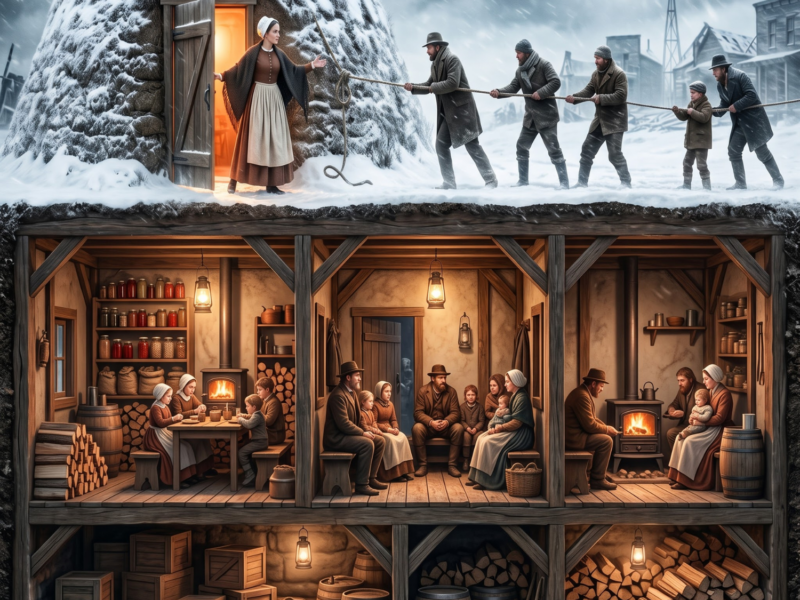
They Mocked Her Sod House—Then a Historic Blizzard Trapped the Entire Town ❄️
The Master Builder
Ezra Holt arrived on a Tuesday in late August.
He rode up the hill and tied his horse to a temporary post Ruth had set near the work site, entirely without asking permission. Ezra was a large, imposing man who had gone lean and sinewy with age. He possessed hands that looked as though they had been violently shaped by the very materials they had spent sixty years manipulating—wood, stone, and iron.
He did not introduce himself immediately. He walked around the unfinished sod structure for close to twenty minutes without speaking a single word. He examined the coursework meticulously. He checked the plumb of the corners by eyeing them against the horizon. He pressed his heavy thumbs into the walls in dozens of different places, applying varying amounts of force to test the density.
Ruth continued working, ignoring him. She was laying a new course on the south face.
When Ezra finally stopped beside the towering eastern wall, his voice was not the mocking tone of the town. It was the serious, measured voice of someone reporting a structural finding to a peer.
“The wall’s too clever, ma’am,” Ezra announced.
Ruth set down her heavy block. She wiped her brow with the back of her forearm, leaving a streak of mud, and waited.
Ezra stepped forward and tapped the outer face of the sod with his knuckles. Three slow, distinct knocks, the exact way a physician percusses a patient’s chest to listen for fluid in the lungs.
“You’ve built two barriers instead of one,” Ezra explained, gesturing to the width. “With an air gap between them.”
His eyes moved from the wall to Ruth’s face, studying her, then back to the wall.
“That’s the worry,” he explained carefully, the tone of a master addressing an apprentice. “Moisture. Moisture trapped inside a wall structure with an air gap will have nowhere to go. Condensation will collect between the layers during the freeze-thaw cycle. It will be invisible from the outside, and invisible from the inside. But it will work slowly, relentlessly, against the organic material at the wall’s core. Rot will establish itself deep within the structure long before any surface sign appears to warn you.”
He stepped back, looking up at the heavy roof timbers she had set.
“The roof concerns me more. You have vastly too much mass above, and far too little ventilation beneath it. A few bad winters of heavy snowpack melting into that sod could turn sound timber into something a man’s hand could push straight through.”
Ezra turned back to her. “A house doesn’t always fail where a man can see it, Mrs. Kalen,” he said. His voice carried absolutely no pleasure in the observation. “Sometimes it fails where he can’t.”
Ruth listened to every single word. She did not cross her arms defensivly. She did not rush to answer or defend her design.
When Ezra finally finished his critique, she walked over to the north end of the building. She pointed a mud-stained finger to a narrow, cleverly disguised gap that ran along the roofline. It was extremely easy to miss, deliberately designed to look like an incidental flaw in the sod packing. Then, she walked him to the opposite end and pointed to a corresponding gap on the south side.
“Air moves through there,” Ruth stated flatly.
She let him study the openings for a long moment before she continued, her voice possessing the same flat, factual tone as his.
“The system is designed to be slow enough to hold the radiant heat inside the living space,” she said. “But fast enough to carry the condensation moisture out.”
She said absolutely nothing more.
Ezra examined both openings in profound silence. He walked back and examined the wall gap again. He stepped back and studied the overall roof geometry, doing complex calculations in his head.
He did not tell her he agreed with her. He did not tell her he disagreed. He simply untied his horse and rode back down the hill toward Cedar Flats.
Neither of them had convinced the other of anything. But they had both established the only thing that mattered: they were both paying serious attention.









