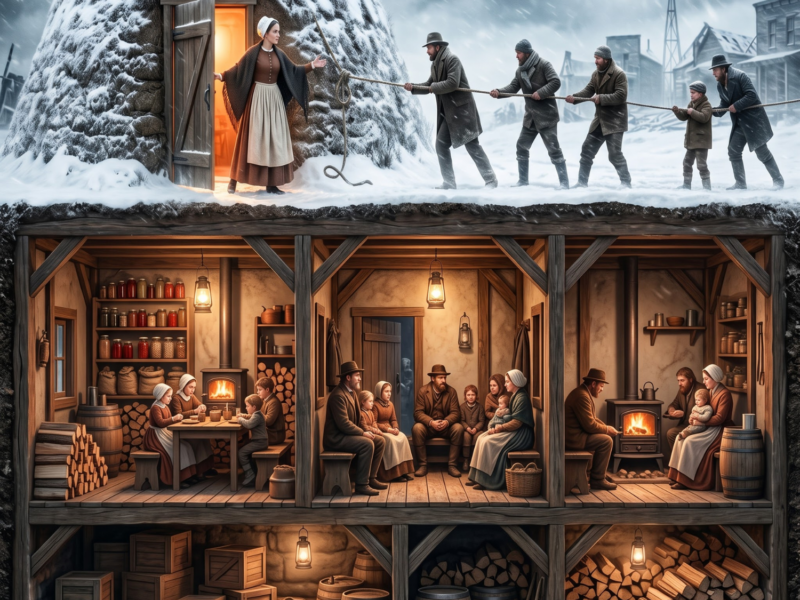
They Mocked Her Sod House—Then a Historic Blizzard Trapped the Entire Town ❄️
The White Eradication
The wind did not build gradually to a crescendo. It simply arrived.
One moment, the air was moving with the restless, directionless energy of a weather system in transition. The very next moment, it was a solid wall. This was not a metaphor. It was not a poetic approximation. It was a physical mass of hyper-dense, arctic air that struck the town of Cedar Flats from the northwest with the flat, concussive force of a freight train that had been traveling for a thousand miles and had not slowed down to hit them.
The temperature dropped fifteen degrees in the time it takes a person to walk from one side of a kitchen to the other.
Snow did not fall from the sky. It violently exploded upward from every surface simultaneously. It was lifted from the ground in solid, blinding sheets that moved horizontally at a speed that rendered the distinction between ‘up’ and ‘down’ utterly irrelevant.
Within four minutes of the wind’s arrival, the town of Cedar Flats ceased to exist visually. It was not merely damaged or struggling. It was erased. It vanished behind a roaring curtain of blowing white so incredibly dense that a person standing in the dead center of Main Street could not see the buildings ten feet away on either side.
Ruth felt the wind change direction violently against her back while she was still on the downward slope below the rise. She had been moving toward town for less than ten minutes when the full, apocalyptic force of the storm overtook her.
She pulled the heavy rope coil tighter against her chest, lowered her head, leaned aggressively into the northwest at an acute angle that put the killing wind behind her left shoulder rather than full in her face, and she kept moving.
She had tied a long, strong guide-line to the anchor post at the very top of the rise before leaving. The other end was tied securely around her waist, giving her a fixed, physical lifeline to find her way back to the fortress.
The town’s anchor points were already locked in her memory. She had practiced. She had deliberately walked the route between her hill and the schoolhouse in normal conditions often enough that her boots knew the subtle variations in the ground, even when her eyes were rendered completely useless by the whiteout.
The schoolhouse appeared only when she was close enough to physically run into it.
She heard it before she saw it. Not the building itself, but the terrible sound it was making. The structure was emitting a continuous, agonizing, low groan, layered beneath the deafening roar of the wind. It was the specific, terrifying frequency of timber under extreme lateral load—a sound that any builder learns to instantly recognize as a structure asking a fatal question it has not yet answered about its own breaking point.
She found the wooden door by feel, her heavily gloved hand moving blindly along the shivering siding until it hit the frame, then sliding down to the iron latch. She pulled it open against the wind’s immense resistance. The storm pressed against the door with such staggering force that it felt as though the building were actively trying to keep her out, rather than the weather trying to keep her in.
She forced her way through. Snow followed her inside like a living, hungry thing.
Eighteen terrified faces turned toward the door.
Agnes Moore was on her feet in the dead center of the room. She had her heavy coat already on, a wool blanket draped over one arm. The potbelly stove behind her glowed with the dark, dangerous red of iron pushed far past its comfortable operating temperature.
Agnes had been burning it as hot as the metal would take, which meant she had already understood, long before Ruth arrived, that the room was actively losing the battle with the cold.
The far wall of the schoolhouse had a visible, terrifying lean to it that had not been there in the morning. It was not a catastrophic collapse yet, but it was imminent. The timber frame was violently transferring load it had absolutely not been designed to carry. The plunging cold was doing what severe cold does to wood under massive stress—making it brittle, making each agonizing creak a little more final than the one before.
Agnes had her students gathered tightly near the glowing stove in the center of the room. The youngest children were innermost, closest to the heat; the older children formed an outer ring, instinctively creating a geometry of biological protection.
Agnes looked at Ruth. Her voice was incredibly steady, in the specific way that voices go steady when a person has accepted that panic is no longer a useful option.
“I was trying to decide whether moving them was more dangerous than staying,” Agnes shouted over the groaning timber.
Ruth dropped the heavy rope coil onto the floorboards without ceremony. “The building won’t last the night.”
Agnes looked at the dangerously leaning wall. She had known this in her gut. Hearing it stated plainly by someone who had just walked through the apocalypse to say it removed the paralyzing weight of uncertainty.
“Then we go,” Agnes said, her chin lifting slightly, aggressively committing herself to the action before her terror could file an objection.
Ruth moved down the huddled line of children with the focused, terrifying efficiency of someone executing a military plan that has been obsessed over in advance. She pulled her knife and cut the heavy hemp rope into precise lengths.
Each child was paired off. Older with younger. Larger with smaller. The pairing was deliberate, based on what Ruth could instantly assess in thirty seconds about each child’s physical mass relative to their neighbor.
She used the short rawhide tethers to connect each pair to the main lifeline. The spacing kept them close enough to maintain physical contact, but without so much slack that a fall by one child could violently pull two children down into the snow instead of just one.
She worked rapidly from the rear of the line forward. Agnes moved right behind her, physically checking the knots with the hyper-focused attention of a woman who was going to be responsible for the rear of this human chain, and intended to understand the structural integrity of every single connection in it.
The children watched her work in a silence that was absolutely not the silence of calm. It was the horrific silence of people who have moved so far past the register of normal fear into trauma that it required all their available mental energy just to keep standing.
A little girl named Lucy, who could not have been more than six years old, was crying without making a single sound. Tears were freezing as they moved down her face, while her expression showed something much closer to intense concentration than grief—as though crying was a physical reflex her body was performing entirely without her mental participation.
An older boy, maybe eleven, had already taken the trembling, mittened hand of the smaller child tethered beside him. He had not been told to do this. He had simply, instinctively done it.
Ruth reached the front of the line. She wrapped the leading end of the main rope tightly around her own waist twice, tying it off with a complex knot that absolutely would not slip under massive load.
She looked at Agnes, who had secured the trailing end around her own waist with similar, desperate knots.
Ruth looked down the line of eighteen children. Their faces were pale with terror. Their eyes were tracking her every movement with the complete, unblinking attention that human beings only give to the person they have decided to follow into a situation they know they cannot survive alone.
“Nobody lets go,” Ruth shouted.
Three words. Spoken once. In a tone that did not invite negotiation and did not require repetition.
Then, she pushed the groaning door open and stepped out into the white.









