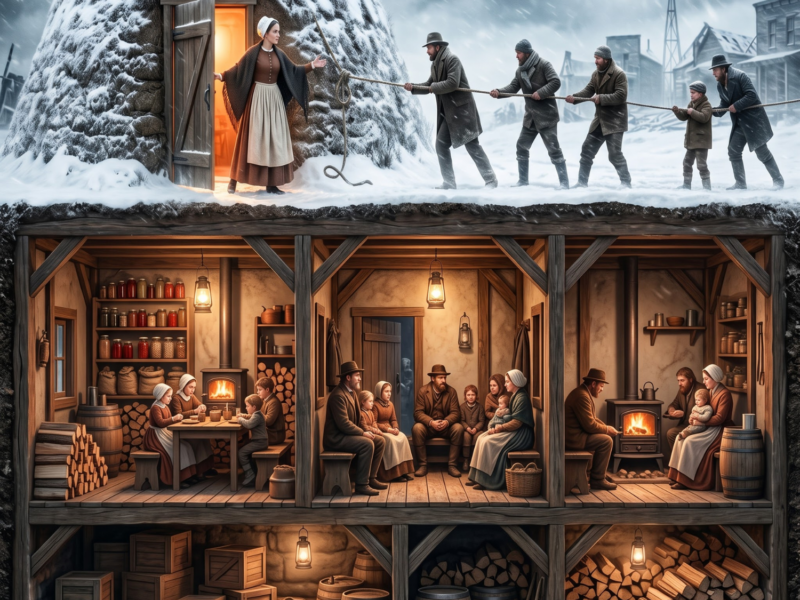
They Mocked Her Sod House—Then a Historic Blizzard Trapped the Entire Town ❄️
The Tether
The world outside the schoolhouse door was no longer a geographical place. It was a terminal condition.
The wind struck Ruth full in the face with a physical force that drove her back a half-step before she could plant her boots and find her footing. Snow entered her mouth and choked her before she had even closed it from speaking.
She violently turned her body to put the screaming wind off her right shoulder. She oriented herself toward where she knew the hill was, rather than where she could see it—which was nowhere—and she began pulling.
The rope behind her tightened sharply as the first pair of children came stumbling through the door, fighting the wind. It tightened even more as the next pair followed. The dead weight of the line grew exponentially with each addition, until Ruth felt the full, agonizing resistance of eighteen children being dragged through a hurricane of ice that actively did not want them moved.
She moved anyway.
The storm was not loud in the way that thunder or explosions are loud. It was loud in the way that absolute silence is total. It filled every single auditory frequency, leaving no space for any other sound to exist in the brain. The world consisted entirely of wind, plus the specific, exhausting sensory input of her own body moving through an invisible wall of resistance.
She felt the frozen ground through the thin soles of her boots. She felt the agonizing pull of the rope cutting into her waist. She counted her steps in her head, because counting was the only way of staying mentally oriented when the universe offered zero external reference points.
Twenty steps from the schoolhouse door, Cedar Flats had fully, conceptually ceased to exist as a visual object. There was only the ground underfoot, the heavy rope dragging behind her, the wind screaming from the right, and the fortress somewhere ahead in the void.
Suddenly, the rope went rigidly taut around her waist, jerking her backward.
Ruth stopped instantly. She turned against the wind, pulling herself back along the tension of the line with hand-over-hand movements, letting the rope guide her blindly through the whiteout to the source of the arrest.
She found the problem at the fifth pair from the rear.
Willie Crane, seven years old, the son of the widow Ida Crane, was on his knees in the snow. It was not from a clumsy fall. His legs had simply stopped cooperating. The hypothermia had rapidly taken something essential from his muscles that his willpower was desperately trying to replace and could not. He was still reaching upward weakly with both arms. He was still trying. But his small body had gone past the biological point where ‘trying’ was the relevant variable.
Agnes was already there, screaming something lost to the wind, her hands under the boy’s arms trying to haul him up. Two of the older students were blindly trying to help support his dead weight while simultaneously fighting to maintain their own footing in the gale.
The geometry of the problem was clear to Ruth instantly, and it was not solvable by the freezing people currently applying themselves to it. They were losing momentum. If they stopped moving for more than a minute, they would all die right there in the street.
Ruth grabbed the lead rope trailing from her waist. She placed that rope firmly into the freezing hands of the oldest student in the line—a boy named Carter, thirteen years old, with the broad build of someone who had been doing grueling farm work since he was old enough to hold a pitchfork.
Carter’s terrified face asked the question before his numb mouth could form it.
“Keep moving!” Ruth screamed over the roar, pointing blindly into the white. “Follow the angle of the wind!”
Carter’s jaw set. His hand closed like a vice on the rope. He turned his face forward into the ice. The line began moving again, dragging slowly behind him.
Ruth bent down. She got her arms under Willie Crane’s limp body, shifted his center of gravity, and hoisted him up. He was small, but dead weight is a very different thing than carried weight. The wind immediately pushed sideways against the combined surface area of both of them with a force that did not discriminate between the rescuer and the child being rescued.
She got him onto her left shoulder, his limp arms falling across her back, turning his face away from the biting wind, shielding him with her own body. She felt his faint pulse fluttering against her neck. It was there.
She turned back toward the front of the line, found the main rope, wrapped her free hand around it in a death grip, and began moving forward again.
What happened next was not cinematic or heroic in any grand sense. It was agonizingly slow, brutally repetitive, and entirely unremarkable in its mechanics.
One step. Then the next step. The wind pushed violently. She leaned harder into it. The rope pulled backward. She kept her hand clamped on it. The dead weight of the boy on her shoulder did not diminish; it seemed to grow heavier with every yard. The distance to the hill did not reveal itself.
She counted steps again. She lost count around sixty. She began again.
At some point, the wind shifted a few degrees, and she instinctively adjusted her angle of approach without consciously thinking about it—the way a person adjusts their balance for a slope underfoot without breaking stride. The rope was her only horizon. The frozen ground was her compass. Everything else was a screaming white void.
The wooden gate post at the base of her hill found her outstretched hand before her eyes ever saw it.
She recognized it instantly by shape. It was the specific, flat-top post she had driven deeper than any other when she built the rope guide system years ago. She had selected it specifically for this exact purpose, because its position marked the critical transition from the open, deadly prairie to the sheltered, upward approach to the rise.
She stopped. She let the rope pile loosely against her legs as the chain of freezing children caught up, collapsing the distance between them as they bumped blindly into one another.
She waited until she felt Agnes tug twice sharply at the far end of the line. It was the signal they had not discussed, but that both women implicitly understood to mean: Everyone is still accounted for.
Two tugs.
Ruth turned uphill.
The structure appeared through the whiteout the way substantial things appear in a blizzard. Not gradually. Not by becoming incrementally visible as a shadow. But by simply, suddenly being there when the physical distance had closed enough to make visibility irrelevant. One moment there was nothing but blinding white death. The next moment, there was a massive wall of black earth.
Ruth’s shoulder hit the heavy outer door before her eyes even confirmed it was wood.
She shoved the door inward.
Warm air moved against her frozen face. It was not the aggressive, stinging heat of a fire burning at its absolute limit. It was the settled, even, profound warmth of a massive space that had been holding a steady temperature for days without interruption. It was a warmth that had been stored patiently in mass, rather than generated frantically by combustion.
The first child stumbling through the door stopped dead just inside the vestibule. The boy stood in the warmth with his eyes closed for a moment. It was the way a person stands in the first real warmth after experiencing genuine, life-threatening cold—not savoring it, just absorbing it. Just letting his terrified body begin to believe that it wasn’t going to die.
Then, the child behind him pushed forward, the moment ended, and they all came pouring through the door in the accelerating, chaotic way of people who have been surviving in sequence, and are now, finally, allowed to stop.









