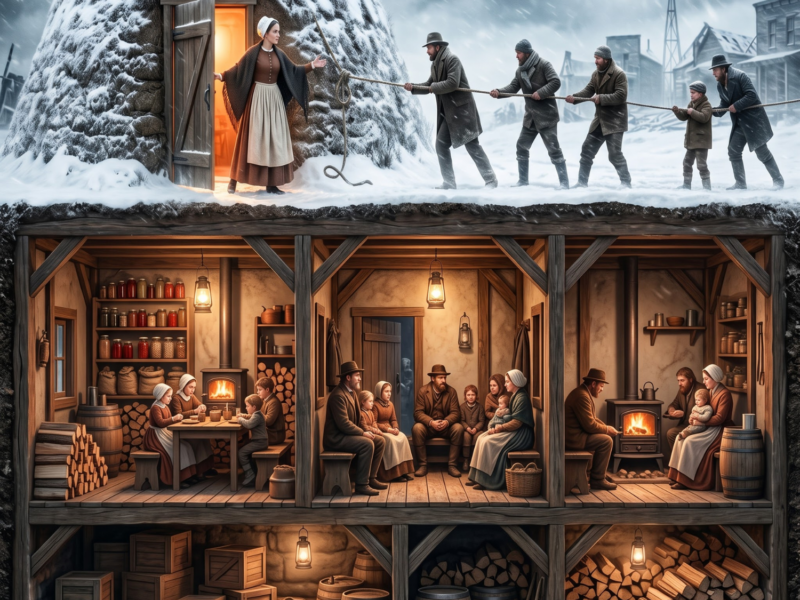
They Mocked Her Sod House—Then a Historic Blizzard Trapped the Entire Town ❄️
The Fortress Completed
By the autumn of 1882, the monumental work was finally finished.
What stood on the rise northwest of Cedar Flats no longer resembled a chaotic construction site. But it also no longer resembled absolutely anything else that had ever been built in that part of Nebraska.
The outer walls rose organically from the prairie soil in thick, uninterrupted courses. They were dense, dark with packed earth, their surfaces sealed smooth with the clay mixture that had permanently stained Ruth’s hands through three full seasons of labor.
Inside those massive outer walls stood a second wall. It was separated from the first by a narrow, dark passage, not wide enough for a person to walk through easily. It was not designed for movement; it was designed purely for resistance. It was a thermal buffer zone where the brutal winter air would be forced to slow down, losing its kinetic energy before it could ever reach the living quarters beyond.
The physics were brutally simple. Moving air carries heat away from warm surfaces. Still air holds it.
Walt Prior had built his rescue shelter into a south-facing hillside for the exact same reason, without ever needing to use the academic words to describe it.
Beneath the structure, accessed by a trapdoor and a ladder, the root cellar disappeared eight feet deep into the earth. Ruth had carved it out by hand over two winters, expanding it inch by inch each spring when the ground softened just enough to work with a pickaxe.
Heavy wooden shelves lined three of the dirt walls. They were already overflowing. Potatoes in deep bins. Turnips in slatted crates. Dried beans in heavy cloth sacks. Preserves and sealed glass jars of vegetables. Huge slabs of smoked meat wrapped in cheesecloth hung from the heavy ceiling joists.
The temperature underground in the cellar stayed safely above freezing regardless of what apocalyptic weather the air outside chose to unleash. It was, Ruth had mathematically calculated from her own extensive records, the most thermally reliable space on the entire property.
Along the south face of the main structure, she had built a low livestock shelter. It was not a separate, freestanding barn out in the yard. It was a connected extension, sharing a massive common wall with the main living room.
The design was, again, simple arithmetic. Large animals produce immense heat as a biological byproduct of simply existing. And heat was the most precious resource on the plains in winter.
The shared wall between the livestock shelter and the main room was a single layer of thick sod, with no air gap. This allowed the radiant animal warmth to conduct directly through the earth into the house without requiring any active management. Bessie the mule lived there. Three other animals lived there. They passively contributed to the survival temperature of the structure, just as the hidden ventilation channels contributed to its moisture balance—passively, reliably, without anyone ever having to chop a piece of wood to make it happen.
Then there was the eastern addition. It was vastly larger than it needed to be for a family of three. It featured a ceiling high enough for a tall man to stand in, and a floor space that could accommodate far more than its nominal purpose as secondary storage suggested. It had been built without any explanation to the town.
When Tom had asked about it once, sweating as he laid the final courses, Ruth had said only, “Extra space costs significantly less to build now than to add later during a blizzard.”
He accepted this logic. Norah, who was infinitely more observant about the specific qualities of her mother’s silences than Tom was, understood instantly that the extra space was absolutely not for storage. But she did not say so aloud.
Above everything rested the massive roof. It was layered in thick rye straw and dense buffalo grass to a depth that other professional builders in the region considered utterly, dangerously excessive. It was thick enough to hold the radiant warmth securely inside, and heavy enough to require the massive, extra internal roof supports Ruth had insisted on installing.
It was designed to shed water cleanly over the edges, without allowing moisture to pool and pull at the seams where it would eventually find its way down into the structural walls.
It did not look elegant. It lacked the soaring rooflines and painted trim of the houses in town.
It looked, as one man from town crudely put it while staring up at the finished building, “Like the damn hill just grew a lid.”
He meant it as a biting insult. Ruth, who overheard the comment carrying on the wind from the work site, thought it was actually an incredibly accurate, beautiful description.
Ezra Holt came in the days immediately following the completion to look at the finished structure. He brought the same rigorous, clinical attention he had brought to the unfinished one years prior.
He walked slowly through the interior rooms. He examined the hidden ventilation channels far more carefully than he had been able to before the roof was on. He ran his calloused hands along the interior wall faces and the ceiling joints, specifically targeting the areas where the moisture risk was mathematically highest.
He spent a long time standing in the livestock shelter, checking the shared wall surface for any signs of weeping condensation.
He did not find what he had fully expected to find.
He found bone-dry walls. He found perfectly still, temperate air. He found a roofline that behaved exactly the way Ruth had confidently said it would—moving ambient air through the hidden channels at a precise rate that held the warmth inside, but prevented dangerous moisture accumulation.
He left without making a formal statement of approval.
But before he untied his horse from the post, he stopped and looked at the building for a long, long moment. His expression was the distinct, private expression of a proud man actively revising a mathematical number he had been absolutely confident about for years.
Ruth noticed the look. She wrote in her notebook that evening:
Ezra Holt visited. Examined roof channels. No questions asked.
One afternoon in early November, with the structure finally complete and the first real, biting cold of the season beginning to settle heavily over the prairie, Ruth set a small, final test for herself.
She placed four glass oil lamps at four distinct points inside the main room, each near a different wall. She lit them in the diminishing, gray afternoon light.
The smoke from each flame rose in a thin, fragile column toward the ceiling.
In any ordinary, wood-framed frontier house, the aggressive air movement created by freezing drafts pulling through poorly fitted boards and gaps in the construction would have violently pulled those smoke columns sideways toward the leaks. The smoke would have traced an invisible, chaotic map of the building’s structural failures.
Ruth stood in the center of the room and watched the smoke from all four lamps.
The columns rose straight up. They barely moved.
The air inside the massive room was nearly perfectly still. It was not “dead” air, which would lead to suffocation; it was controlled air. It was air that moved intentionally through the ventilation channels she had designed, rather than aggressively through the accidental, lethal gaps that characterized most buildings in Cedar Flats.
She stood with that profound realization for a while, watching the flames.
Harlon Briggs had not come up the hill. He had not asked questions. He had not changed his loud, public position on the project by so much as a single syllable.
But one evening in early October, Ruth had looked down from the rise and seen a solitary figure standing on the road below, facing uphill in the gathering dusk. She recognized Harlon’s expensive coat and his horse. He stood there for several minutes, absolutely motionless. He stood long enough that the observation felt intensely meaningful rather than accidental.
Then, he turned his horse and rode quickly back toward town.
The next day, at his crowded store, when Kalen’s Grave came up in conversation, as it periodically did for amusement, Harlon laughed. His laugh was the exact same booming laugh he had always used.
But something in the room felt slightly different to the men listening. It felt a fraction of a degree cooler. It felt like a heavy door that had been opened briefly, and then quietly, firmly closed.
Ruth did not mark the moment as a victory when she heard the gossip. She marked it in her notebook neutrally, entirely as data.









