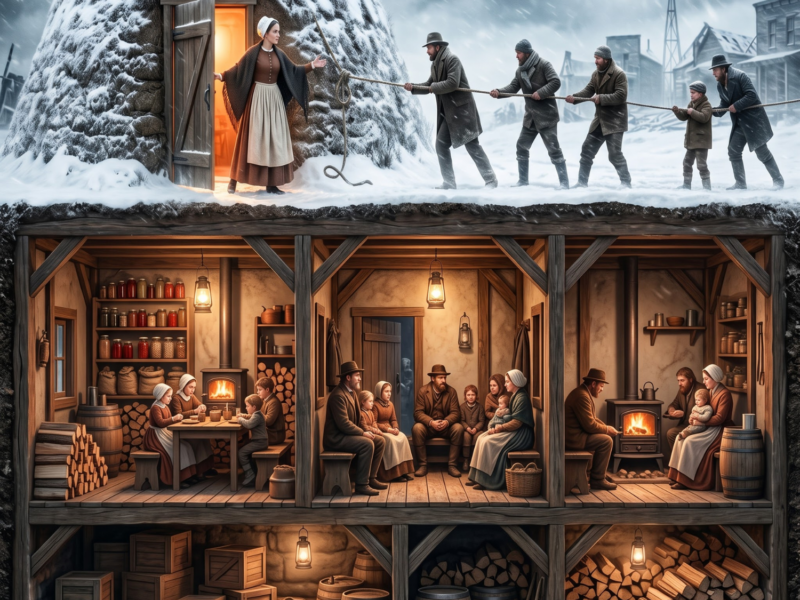
They Mocked Her Sod House—Then a Historic Blizzard Trapped the Entire Town ❄️
The Verdict of the Morning
The storm ended before dawn. It did not end with a final, dramatic gust, but with the gradual, exhausted withdrawal of something that had satisfied its fury and moved on.
The wind diminished in stages. The snow settled back to the ground. By the time the sky began to lighten into a pale gray, the prairie was utterly still. It was the terrifying silence after the storm—sitting over Cedar Flats with the peculiar, heavy weight of an absence where a violent presence had been.
Ruth opened the heavy outer door at first light.
Cold air entered the vestibule. Sunlight followed—pale, weak winter sunlight. The kind that illuminates everything clearly without offering an ounce of actual comfort.
She stepped outside.
The rise beneath her boots was relatively unchanged. It was the same frozen ground, the same sparse winter grass protruding through the snow, where the massive structure’s aerodynamics had moderated the drifting.
She turned and looked down toward Cedar Flats.
The town below looked as though the night had violently passed through it, rather than over it.
The schoolhouse had lost its roof completely. The timber frame had failed sometime in the early hours. The boards that had been creaking since the afternoon had finally completed the conversation they had been having with the storm. The roof had pancaked inward, the walls splaying outward into the drifts. The whole structure had collapsed into a chaotic shape that was less a building than a shattered record of the forces that had ended it.
The east wall that had been ominously leaning when Ruth collected her students was now lying perfectly flat in the snow, partially buried by the massive drift that had formed over it.
If eighteen children had still been inside that building at midnight, the conversation about what the town would be discussing this morning would absolutely not be about property damage.
Harlon Briggs’s General Store had lost its entire front face. The storefront wall had failed cleanly, shearing away from the floor and roof framing in a single, catastrophic release of tension, spilling the store’s precious contents out into the street-level snow. Barrels of flour, crates of tools, shelving—the accumulated, hoarded inventory of Cedar Flat’s primary merchant lying ruined in the drifts like the aftermath of a flood.
The building was structurally compromised on three sides. It would require complete, expensive reconstruction, not just a repair. The pride of the commercial district, the building that had served as the settlement’s gathering place for years, looked like a wreck abandoned after an artillery strike.
Several residences showed devastating variations of the exact same damage. Missing roofs. Failed walls. Structures that had been comfortably inhabited at noon yesterday were sitting wide open to the freezing sky this morning, their interiors packed solid with wind-driven snow that had been free to enter through gaps that the building’s original, hasty construction had only managed to conceal in calmer conditions.
Behind Ruth, the sod structure stood exactly as it had stood the day before. Exactly as it had stood the week before. Exactly as it had stood for two years since completion.
The walls were perfectly in their courses. The heavy roof was intact. The chimney stood vertical. The outer door swung on its original iron hinges without a fraction of an inch of resistance. The east wing had sheltered more than thirty panicking people through the night without showing a single hairline crack in its ceiling or a single distortion in its framing.
Bessie was in the livestock shelter, eating hay with the serene, infuriating indifference of an animal that has survived much worse than this, and fully expects to survive worse than that tomorrow.
People came out of the shelter slowly.
They came through the thick door in ones and twos, stepped onto the frozen ground, turned to look down towards Cedar Flats, and stopped dead.
The stopping was not dramatic. It was the abrupt stopping of people absorbing evidence that their eyes were providing vastly faster than their traumatized minds could process. They stood in the pale morning light and looked at the ruined town, then turned around and looked at the massive, unbroken structure behind them, then looked down at the ruined town again.
Some of them did this several times, as though physical repetition might resolve the staggering cognitive weight of the comparison.
Agnes Moore stood at the crest of the rise for a long time, looking from the collapsed, pancaked schoolhouse to the impenetrable building behind her.
She had been a teacher for three years. She would be a teacher for many more. She would remember this morning for the rest of her life—not as the morning after the storm, but as the morning she understood something specific and profound about the difference between hope and preparation. A building could be hoped for. A building had to be built.
She turned to look at Ruth. “The walls held.”
It was not a casual observation. It was a recognition of something that mattered vastly more than she had ever known how to measure, until the storm had done the brutal measuring for her.
Harlon Briggs stood at the bottom of the rise and looked at what remained of his ruined store for a very long time before he slowly walked up the hill.
When he finally came up to where the group of survivors was gathered, he moved with the deliberate, heavy pace of a man who has decided that the thing he is about to do is necessary, and has committed to the necessity before his ego can renegotiate the terms.
He found Ruth. He looked at her directly, with the full, uncomfortable directness of a person putting down a heavy thing they have been carrying, and openly acknowledging the crushing weight of it.
“I called this place a grave,” Harlon said.
He let the sentence exist in the cold air without addition for a moment.
“When the storm came, it kept my family alive.”
There were no qualifications. No redirection toward future uncertainties. Just the plain, brutal arithmetic of what had happened.
Cecil Pratt stood nearby and heard this. The Mayor of Cedar Flats, who had patronizingly suggested at a public gathering that a woman who wanted neighbors should build a home rather than a fortification, looked down at the ruined buildings below his feet. He did not attempt a defense of his former position.
“I was wrong,” the Mayor said, simply enough that the simplicity was itself a kind of dignity.









